
EOT: What an Extension of Time Means and How It Works under FIDIC
EOT (Extension of Time) is an extension of the Time for Completion under a FIDIC contract. We explain what the term means, where to find it in the 2017 Red and Yellow Books (Sub-Clauses 8.5 and 20.2), the procedure step by step with its time limits, and the mistakes that cost contractors their entitlement.
 Larissa Belousova
EOT stands for Extension of Time: an extension of the Time for Completion under a FIDIC contract. It moves the contractual completion date when a delay is caused by something the contract places at the Employer’s risk, or by a neutral event such as an Exceptional Event under Clause 18. An EOT does not bring additional payment by itself: it moves the completion date, and the contract is then administered from the new date.
In brief: EOT (Extension of Time) is the extension of the Time for Completion a contractor is entitled to when a ground expressly named in the contract occurs. In the FIDIC 2017 Red and Yellow Books it is Sub-Clause 8.5, and the claim procedure is in Sub-Clause 20.2: a notice within 28 days and a fully detailed claim within 84 days. Without a proven effect on the critical path, no extension is granted.
What an EOT is and when the entitlement arises
The entitlement to an EOT arises when two conditions are met: the event is one of the grounds listed in the contract, and it actually moves the completion date. A delay to an activity that has float may not touch the critical path and may give no extension at all.
Larissa Belousova wrote on her channel about how the EOT procedure differs between the editions:
«The right to an EOT exists in both editions. But in 2017 the emphasis is on the Engineer making a timely determination, which disciplines the process and reduces the likelihood of disputes at the end of the project. For the contractor the key rule remains the same: give notice in time, or the right is lost.»
Where EOT sits in a FIDIC contract: Sub-Clause 8.5 and Clause 20 of the 2017 edition
In the FIDIC 2017 Red and Yellow Books the grounds for an extension are gathered in Sub-Clause 8.5, and the claim procedure is in Clause 20, chiefly Sub-Clause 20.2. In the 1999 edition claims are governed by Sub-Clause 20.1 and Clause 8 is numbered differently: there is no Advance Warning obligation, for example.
So the clause number is always checked against the edition named in the contract: a reference familiar from one book may point to a different mechanism in another. In the 2017 Silver Book claims and disputes are also in Clauses 20 and 21, but the Engineer’s role is performed by the Employer’s Representative.
- delayed drawings or instructions (Sub-Clause 1.9);
- failure to give access to or possession of the Site on time (Sub-Clause 2.1);
- Unforeseeable physical conditions (Sub-Clause 4.12);
- Variations and additional work (Clause 13);
- Exceptional Events (Clause 18; formerly called force majeure);
- other grounds expressly named in the Particular Conditions of the contract.
How an EOT works in practice: steps and time limits under FIDIC 2017
| Step | Time limit under the General Conditions | Sub-Clause |
|---|---|---|
| Notice of Claim | 28 days after the party became aware, or should have become aware, of the event | 20.2.1 |
| Engineer's objection that the notice is late | 14 days | 20.2.2 |
| Fully detailed Claim with the calculated effect on time | 84 days | 20.2.4 |
| Consultation between the Parties to reach agreement | 42 days | 3.7 |
| Engineer's determination if there is no agreement | the following 42 days | 3.7 |
| Notice of Dissatisfaction with the determination | 28 days, otherwise the determination is final | 3.7 |
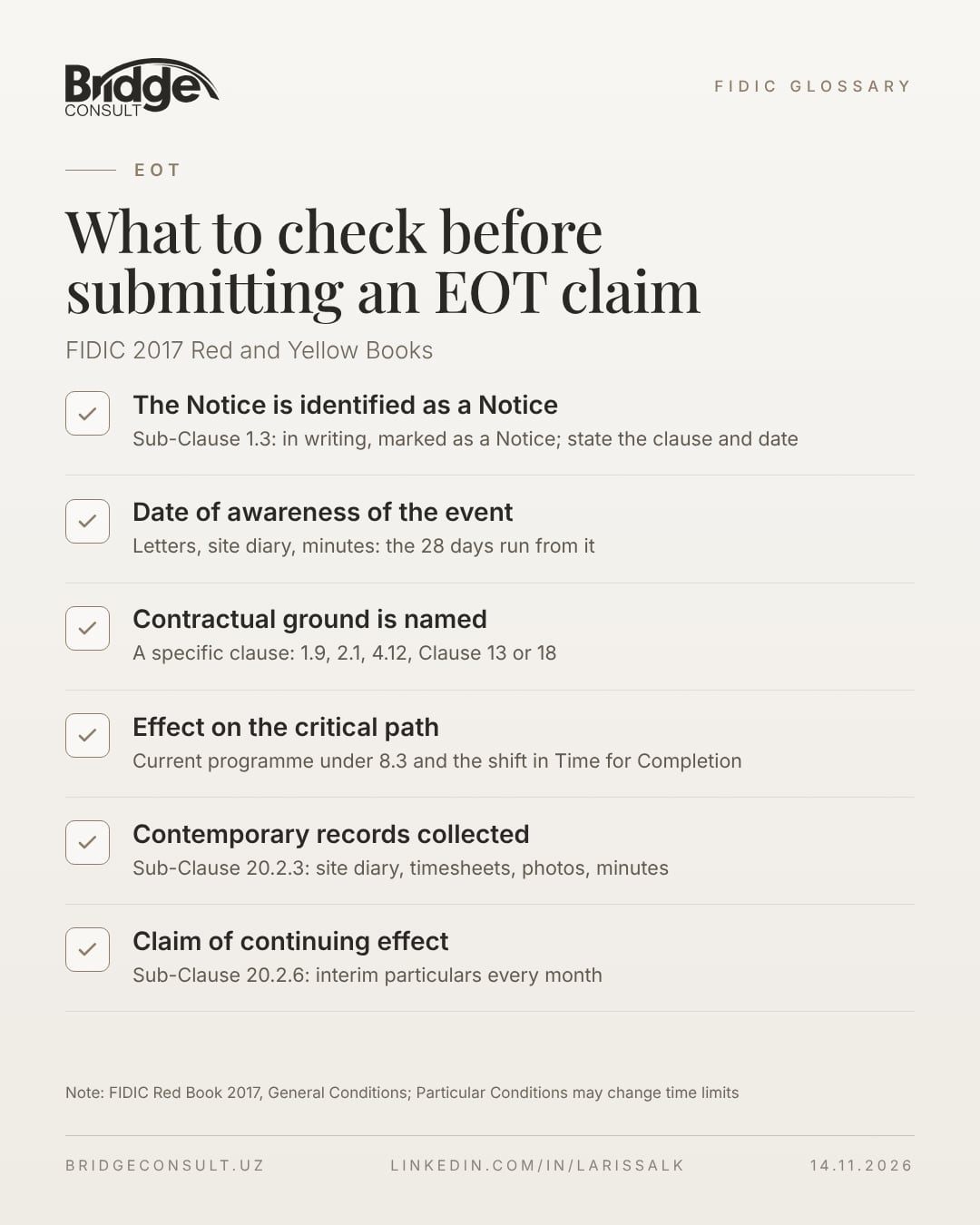
If the event continues, the claim is made as a claim of continuing effect: interim particulars are submitted monthly (Sub-Clause 20.2.6). Once the extension is agreed or determined, the Time for Completion moves, and delay — and therefore Delay Damages under Sub-Clause 8.8 — is counted from the new date.
If a party disagrees with the determination and has given a NOD, the dispute goes to the DAAB under Clause 21: the decision is given within 84 days, a NOD against it may be given within 28 days, then 28 days are allowed for amicable settlement, after which arbitration is possible. How that board works is explained in the glossary entry on the DAAB, and the money side of delay in our article on extensions of time and delay damages.
Common mistakes when claiming an EOT
- Missing the 28 days for the notice. Under the 2017 edition this puts the claim at risk of being lost (time bar), even where the effect of the delay is obvious.
- A letter instead of a Notice. Under Sub-Clause 1.3 a notice is given in writing and expressly identified as a Notice, so a mention of the delay in minutes of a meeting does not replace it. In practice the Notice also names the Sub-Clause and the date of the event.
- No contemporary records (Sub-Clause 20.2.3): no site diary, oral instructions not confirmed in writing, no photographs or timesheets.
- The programme under Sub-Clause 8.3 has not been submitted or updated, the Engineer has no current version, and there is nothing to measure the effect on the critical path against.
Prevention means an event register, a single log of notices and regular updating of the programme. This is part of day-to-day contract administration on the Contractor’s or the Engineer’s side.
What EOT is confused with: Variation, Exceptional Event and Delay Damages
- Variation (Clause 13) is a change to the scope or character of the Works. It may be a ground for an EOT, but the extension still has to be substantiated and agreed in the way the contract requires.
- Exceptional Event (Clause 18) is a separate ground with its own notice within 14 days (Sub-Clause 18.2). That notice does not replace the Notice of Claim under Sub-Clause 20.2.1.
- Delay Damages (Sub-Clause 8.8) are money for late completion, capped in the Contract Data. An EOT moves the date from which delay is counted and is not a synonym for delay damages.
- Notice of Claim is the first step of any claim, including a money claim. An EOT is only one kind of relief that may be claimed.
- Advance Warning (Sub-Clause 8.4 of the 2017 edition) is a warning of a future risk. The extension of time in that edition is in the neighbouring Sub-Clause 8.5, and the 1999 edition has no Advance Warning.
A separate risk area is concurrent delay: delays running at the same time for reasons attributable to both Parties. The General Conditions do not regulate it directly, so the outcome depends on the Particular Conditions, the governing law and the evidence on the particular project.
Frequently asked questions
What is an EOT in a contract?
EOT means Extension of Time: an extension of the Time for Completion. The contractual completion date moves if the delay is caused by a ground provided for in the contract and the contractor proves its effect on the completion date.
Which FIDIC clause governs EOT: 8.4 or 8.5?
In the FIDIC 2017 Red and Yellow Books the extension of time is governed by Sub-Clause 8.5, while Sub-Clause 8.4 is Advance Warning. The 1999 edition is numbered differently, so always check the clause number against the edition named in your contract.
How many days are there to give notice of an EOT claim?
Under the 2017 General Conditions the Notice of Claim is given no later than 28 days after the party became aware, or should have become aware, of the event, and the fully detailed claim within 84 days. Particular Conditions may change these periods.
Does an EOT give a right to additional payment?
No, not automatically. An extension of time and recovery of cost are different heads of claim: the money part has to be claimed and substantiated separately within the claims procedure.
Sources and references
- FIDIC Red Book 2017, Sub-Clause 8.5
- FIDIC Red Book 2017, Sub-Clause 20.2
- FIDIC Red Book 2017, Sub-Clause 3.7
- FIDIC Red Book 1999, Sub-Clause 20.1
How Bridge Consult can help
Bridge Consult supports employers and contractors on FIDIC contracts — from reviewing conditions and notices to claims, DAAB proceedings and arbitration. Founder Larissa Belousova is a FIDIC Certified Consulting Engineer and an ADB Accredited Contract Management and Dispute Avoidance Specialist.
Have a question about a live contract? Contact us and we will look at your situation.
This term in our articles
- EOT: How a Contractor Can Lawfully Extend Time and Avoid Delay Damages
- FIDIC DAB vs DAAB: what's the difference, and why it matters not to confuse the abbreviations in your contract
- EPC+F Contracts in Uzbekistan: What to Check Before Agreeing the Price
- International Arbitration Against Turkish Investors: What It Means for FIDIC Contracts
- New Bukhara Airport PPP: Which FIDIC Form, Key Risks and a Pre-Signing Checklist
- Summer School Georgia 2026: from practice to theory, video from the sessions
Other terms
FIDIC Uzbekistan
Expert materials, case studies and event announcements on FIDIC contracts in Central Asia — before they reach the site.