
DAAB: what it is, full form and how it works in FIDIC
DAAB (Dispute Avoidance/Adjudication Board) is the standing board for avoiding and resolving disputes under FIDIC 2017 contracts. We set out what the term means, where it sits in the contract (Clause 21), how it works in practice, which time limits apply and how it differs from the former DAB.
 Larissa Belousova
DAAB (Dispute Avoidance/Adjudication Board) is the standing board for avoiding and adjudicating disputes that FIDIC introduced in the 2017 edition. It is with the project from the very beginning, helps the parties keep disagreements from turning into disputes and, if a dispute is referred to it after all, issues a decision on it.
The key word in the name is Avoidance. The board becomes involved before a disagreement becomes a dispute, and that is the main difference from the earlier model, where the dispute body was brought in only once a conflict had materialised.
In brief: DAAB (Dispute Avoidance/Adjudication Board) is the standing board for avoiding and adjudicating disputes under FIDIC 2017 (Clause 21). It is appointed at the start of the project, helps the parties avoid disputes and issues a decision within 84 days of a referral; a dissatisfied party serves a Notice of Dissatisfaction (NOD) within 28 days.
What DAAB means: full form and purpose
DAAB stands for Dispute Avoidance/Adjudication Board, the board for avoiding and adjudicating disputes. It is a body independent of the Employer and the Contractor which operates throughout the term of the contract. Its composition and the procedure for appointing it are set by the terms of the particular contract: the Contract Data and the Particular Conditions.
The board has two functions at once. The first is to avoid disputes: it stays with the project continuously and helps the parties clear up a disagreement before it grows into a dispute. The second is to consider a dispute referred to it and issue a decision.
Larissa Belousova wrote about the transition from DAB to DAAB in her channel:
«The transition from DAB to DAAB was the logical result of accumulated experience: any claim left unattended has every chance of escalating into a dispute, and any dispute inevitably leads to additional time and cost for the project.»
Where DAAB sits in a FIDIC contract: books and the 2017 edition
DAAB is set out in Clause 21 of the General Conditions of the FIDIC 2017 Red Book (Construction) and Yellow Book (Plant & Design-Build). The specific parameters, namely composition, appointment and rules of operation, are set in the Contract Data and the Particular Conditions of the contract.
The Silver Book (EPC/Turnkey) uses a different administration scheme: the Engineer’s role there is performed by the Employer’s Representative. In such contracts, therefore, the composition of the dispute body and the procedure must be checked against the contract itself, not taken over with the clause numbering of the Red or Yellow Book.
How DAAB works in practice: appointment and time limits
The board is set up at the start of the project, not when a problem arises: that is the point of the DAAB’s standing status. How it operates, how often it meets and in what form it receives information about the project, is set by the Contract Data and the Particular Conditions. Once a dispute is referred to it, the time limits in Clause 21 start to run.
- Appointment: the parties appoint the DAAB at the start of the project, with its composition following the Contract Data and the Particular Conditions.
- Ongoing involvement: the board works continuously and helps the parties avoid disputes before they arise.
- Referral: a party formally refers the dispute to the DAAB for a decision.
- Decision: the DAAB issues its decision on the dispute within 84 days of the referral.
- Disagreement: either party may serve a Notice of Dissatisfaction (NOD) within 28 days; otherwise the decision becomes final and binding.
| Stage | Time limit under the 2017 General Conditions |
|---|---|
| Decision after referral of the dispute | up to 84 days |
| Notice of Dissatisfaction (NOD) | 28 days |
| Attempt at amicable settlement after a NOD | 28 days (21.5) |
| Move to arbitration | under 21.6, ICC by default |
| Failure to comply with a DAAB decision | ground under 21.7 |
Common mistakes parties make with the DAAB
- The board is not set up in time: the parties wait for the first conflict and lose the whole point of avoidance.
- The DAAB is used only for adjudication and the avoidance function is ignored.
- The 28 days for a NOD are missed, and an unfavourable decision becomes final and binding.
- The parties come to the board with no evidence: no site diary, minutes, correspondence or programme.
- Local habits of settling matters verbally replace written referrals to the board.
- Editions are confused: the parties try to apply the Clause 21 procedure to a 1999 contract, which has no such procedure.
Sound FIDIC contract support is built precisely on having the board at work from day one rather than brought in after the event. Cases under the 1999 and 2017 editions are covered at the Bridge Consult Academy.
What DAAB is confused with: DAB, the Engineer and arbitration
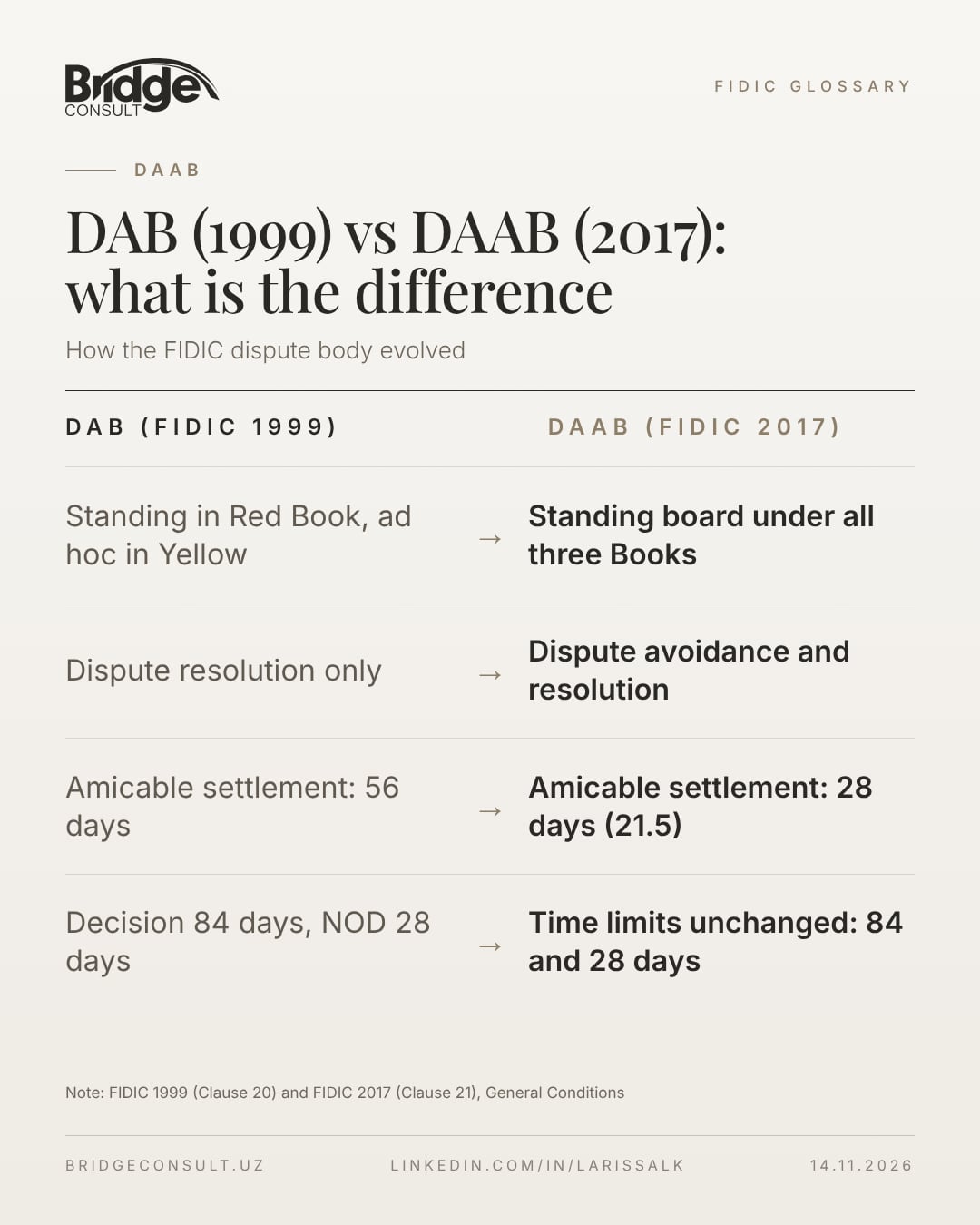
DAB is the predecessor of the DAAB from the 1999 edition (Sub-Clauses 20.2–20.4). There the board only resolved disputes that had already arisen: it was a standing board under the Red Book and an ad hoc one under the Yellow and Silver Books; the decision was issued within 84 days, a NOD was served within 28 days, and 56 days were allowed for amicable settlement (Sub-Clause 20.5). The DAAB became a standing board under all three Books and gained the avoidance function.
The Engineer is not the DAAB. Under Sub-Clause 3.7 the Engineer agrees or determines a matter neutrally, but the Engineer is part of contract administration. The DAAB, by contrast, is an external independent body. Arbitration (ICC by default) comes later: only if a party was not satisfied with the DAAB decision and amicable settlement did not take place.
Frequently asked questions
What does DAAB stand for?
DAAB stands for Dispute Avoidance/Adjudication Board, the board for avoiding and adjudicating disputes under FIDIC 2017 contracts.
What is the difference between DAAB and DAB?
The DAB of the 1999 edition only resolved disputes that had already arisen: it was standing under the Red Book and ad hoc under the Yellow and Silver Books. The DAAB in the 2017 edition is a standing board which, in addition, helps the parties avoid disputes as the project proceeds.
Who are the DAAB members and how are they appointed?
The composition of the board and the procedure for appointing it are set by the terms of the particular contract: look at the Contract Data and the Particular Conditions, since the Particular Conditions amend the General Conditions.
Is a DAAB decision binding?
A DAAB decision is to be complied with by the parties, and Sub-Clause 21.7 is designed for the case of non-compliance. If the dissatisfied party does not serve a NOD within 28 days, the decision becomes final and binding.
Sources and references
- FIDIC Red Book 2017, Clause 21
- FIDIC Red Book 2017, Sub-Clause 3.7
- FIDIC Red Book 1999, Sub-Clauses 20.2–20.5
How Bridge Consult can help
Bridge Consult supports employers and contractors on FIDIC contracts — from reviewing conditions and notices to claims, DAAB proceedings and arbitration. Founder Larissa Belousova is a FIDIC Certified Consulting Engineer and an ADB Accredited Contract Management and Dispute Avoidance Specialist.
Have a question about a live contract? Contact us and we will look at your situation.
This term in our articles
- FIDIC DAB vs DAAB: what's the difference, and why it matters not to confuse the abbreviations in your contract
- What Is a DAAB under FIDIC Contracts — and Why Your Project Needs One
- EPC+F Contracts in Uzbekistan: What to Check Before Agreeing the Price
- International Arbitration Against Turkish Investors: What It Means for FIDIC Contracts
- IFI Tenders in Uzbekistan and Central Asia: November 2026 Overview
- New Bukhara Airport PPP: Which FIDIC Form, Key Risks and a Pre-Signing Checklist
Other terms
FIDIC Uzbekistan
Expert materials, case studies and event announcements on FIDIC contracts in Central Asia — before they reach the site.