
Notice of Claim in FIDIC: the 28-Day Limit and the Time Bar under 20.2
A Notice of Claim is the notice that starts the FIDIC claims procedure and preserves the contractor's entitlement to an EOT and money. We explain the 28-day limit under Sub-Clause 20.2 of the 2017 Red and Yellow Books, how the time bar works and how the Engineer responds.
 Larissa Belousova
A Notice of Claim is a written notice by a party to the contract that it considers itself entitled to an extension of time (EOT) and/or additional payment, and it is this notice that starts the whole FIDIC claims procedure. Under the 2017 edition it must be given no later than 28 days after the party became aware, or should have become aware, of the event. Missing that period risks a time bar: loss of the claim even where it is sound on the merits.
It is the most valuable part of Sub-Clause 20.2: not the claim itself but a short signal that keeps the right to claim alive. Below we look at what counts as the event, how the period runs and what the Engineer does.
In brief: A Notice of Claim is a notice of entitlement to an EOT or money which, under Sub-Clause 20.2 of the 2017 Red and Yellow Books, is given within 28 days after the party became aware, or should have become aware, of the event. Missing the period means a time bar: loss of the right to claim. The notice is not yet the claim: the substantiation follows later, within 84 days.
What a Notice of Claim means in FIDIC
A Notice of Claim is a formal statement that a party considers itself entitled to additional time or money because of a particular event. It is not yet a claim with calculations and evidence but an assertion of entitlement that opens the procedure and stops time running against you.
In the 2017 edition the rule is symmetrical: both the Contractor and the Employer give notice within the same period. The claim may concern an extension of time (EOT), additional payment or another entitlement under the contract.
Larissa Belousova wrote on her channel about the role of the notice:
«A Notice is not the claim itself, but it preserves the right to claim.»
Where it is in the contract: Sub-Clause 20.2 (2017 Red and Yellow Books)
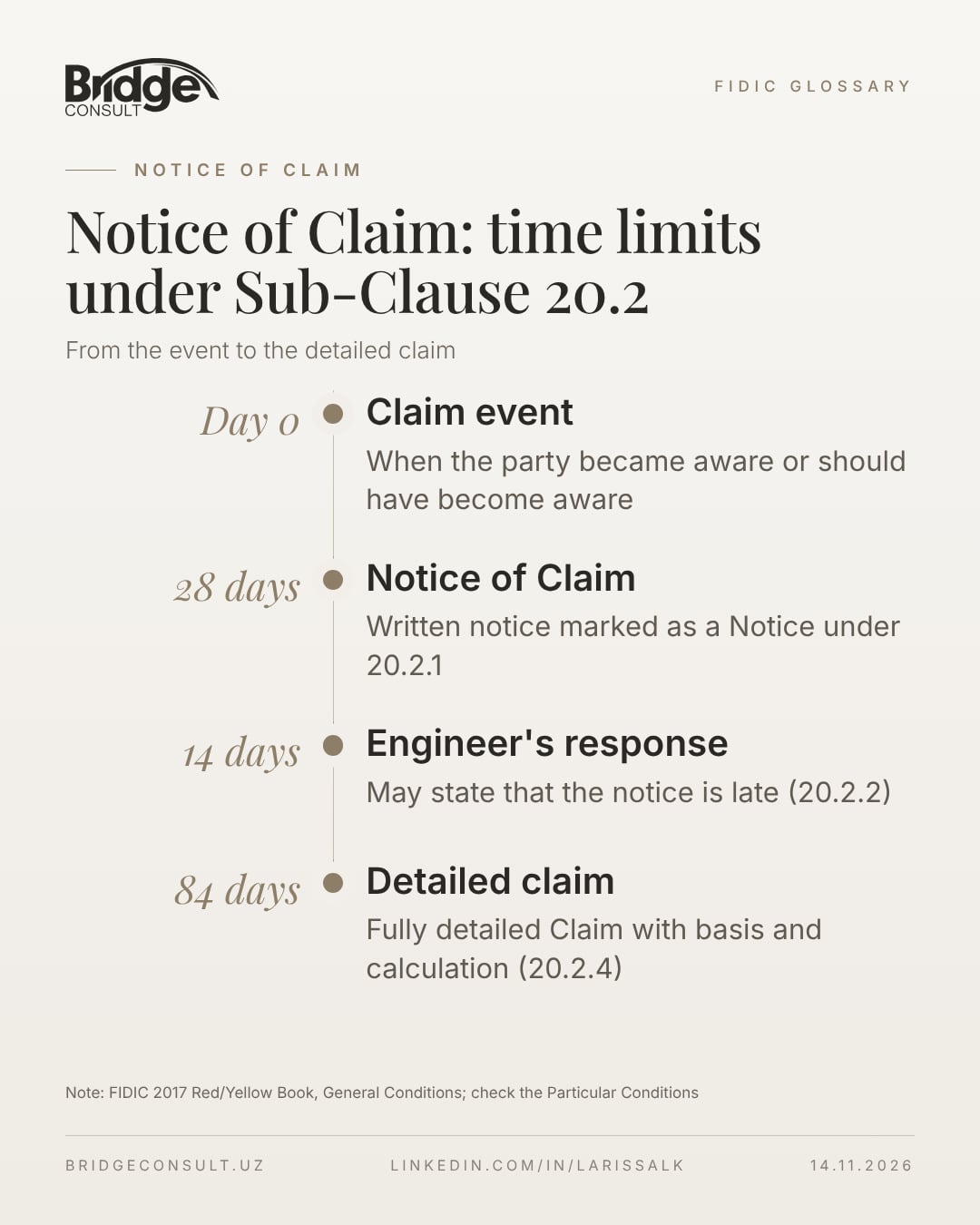
In the FIDIC 2017 Red and Yellow Books claims are dealt with in Clause 20. The Notice of Claim is Sub-Clause 20.2.1: notice no later than 28 days. Then come Sub-Clauses 20.2.2 (within 14 days the Engineer may state that the notice is late), 20.2.3 (contemporary records), 20.2.4 (the fully detailed Claim within 84 days) and 20.2.5 (agreement or determination under 3.7).
In the 1999 edition this logic lived in Sub-Clause 20.1 Contractor’s Claims: notice within 28 days, the detailed claim within 42 days, the Engineer’s response within 42 days. Employer’s claims were governed by a separate Sub-Clause 2.5 with no strict time limit. The two editions are numbered differently, so always name the book and the year when you refer to a clause.
| Item | FIDIC 1999 (20.1) | FIDIC 2017 (20.2) |
|---|---|---|
| Period for the notice | 28 days | 28 days |
| Who gives it | The Contractor only | Both Parties |
| Detailed claim | 42 days | 84 days |
| Effect of missing it | Loss of entitlement | Time bar; 14 days for the Engineer to respond |
How the 28-day period works in practice
The period runs not from a date that suits you but from the moment the party became aware, or should have become aware, of the event. Disputes most often turn on the words “should have become aware”: the moment is fixed both by actual knowledge and by when a reasonable professional contractor ought to have noticed the problem.
- Record the event and the date you became aware of it: a site diary entry, minutes, a letter.
- Give the Notice of Claim within 28 days, in writing and expressly stating that it is a Notice under Sub-Clause 20.2.1.
- Keep contemporary records in parallel: logs, photographs, correspondence, programme data.
- Submit the fully detailed Claim within 84 days, with the contractual basis and the calculation of the EOT or the amount.
- Go through agreement or the Engineer’s determination under Sub-Clause 3.7; if you disagree, give a Notice of Dissatisfaction within 28 days.
The Engineer administers this procedure and records claim events. On development-bank projects a central claim register showing notice deadlines and the status of each claim is useful. If you need help setting up that administration, it is part of our FIDIC contract support.
Common mistakes and the time bar
- Missing the 28 days: the event was noticed but the notice was sent later, or only “once the loss had been calculated”: a direct route to a time bar.
- Vague wording: a letter without the word Notice and without a reference to Sub-Clause 20.2.1 may not be accepted by the Engineer as a notice.
- No supporting records: without a site diary and correspondence there is nothing to support the detailed claim 84 days later.
- Waiting for final figures: notice is given only once all costs are known, although the Notice follows the event and the calculation comes later.
- Oral understandings: it was discussed with the Engineer on site and nobody wrote anything — for the contract that is not a notice.
- Claims of continuing effect handled as one-off claims: Sub-Clause 20.2.6 requires interim particulars, normally every month.
A simple working rule of international practice: when in doubt, send a notice. A Notice is cheap to prepare and preserves the right, while its absence costs the whole claim. You can work through such situations on real cases at the Bridge Consult Academy.
What a Notice of Claim is confused with
- Advance Warning (8.4) is a warning of a future risk to the Works; it is a new obligation in the 2017 edition, it does not replace the Notice of Claim and by itself does not preserve the right to claim.
- Notice of Dissatisfaction (NOD) is disagreement with the Engineer’s determination under 3.7 (28 days) or with a DAAB decision; it comes much later, at the dispute stage.
- Employer’s Claim in the 2017 edition follows the same Sub-Clause 20.2 and the same 28 days, unlike the weaker Sub-Clause 2.5 of the 1999 edition.
- Fully detailed Claim is the substantiation under 20.2.4 within 84 days, not the notice; submitting the detailed claim does not cure a missed Notice.
- DAAB is the next stage if the claim is not agreed; how it works is explained in the entry on the DAAB in FIDIC contracts.
Frequently asked questions
What is the time limit for a Notice of Claim under FIDIC 2017?
No later than 28 days after the party became aware, or should have become aware, of the event, under Sub-Clause 20.2.1 of the 2017 Red and Yellow Books. The period is that of the General Conditions unless the Particular Conditions change it.
What is a time bar in FIDIC?
It is the loss of a claim because the notice period was missed. If the Notice of Claim is not given within 28 days, the party may lose its entitlement to additional payment, an EOT and any other relief for that event.
Can the right to claim be restored if the period was missed?
Not automatically. Under Sub-Clause 20.2.2 the Engineer may state within 14 days that the notice is late, and the circumstances of the delay are then assessed; submitting the detailed claim does not by itself restore the period.
How does a Notice of Claim differ from an Advance Warning?
An Advance Warning under Sub-Clause 8.4 warns of a future risk to the Works, while a Notice of Claim under 20.2 asserts an entitlement to time or money for an event that has already occurred. An Advance Warning does not preserve the right to claim.
Sources and references
- FIDIC Red Book 2017, Sub-Clause 20.2 (Notice of Claim, Fully detailed Claim)
- FIDIC Yellow Book 2017, Clause 20 (Claims)
- FIDIC Red Book 1999, Sub-Clauses 20.1 and 2.5
- FIDIC Red Book 2017, Sub-Clause 8.4 (Advance Warning) and Sub-Clause 3.7
How Bridge Consult can help
Bridge Consult supports employers and contractors on FIDIC contracts — from reviewing conditions and notices to claims, DAAB proceedings and arbitration. Founder Larissa Belousova is a FIDIC Certified Consulting Engineer and an ADB Accredited Contract Management and Dispute Avoidance Specialist.
Have a question about a live contract? Contact us and we will look at your situation.
This term in our articles
- FIDIC DAB vs DAAB: what's the difference, and why it matters not to confuse the abbreviations in your contract
- EPC+F Contracts in Uzbekistan: What to Check Before Agreeing the Price
- International Arbitration Against Turkish Investors: What It Means for FIDIC Contracts
- New Bukhara Airport PPP: Which FIDIC Form, Key Risks and a Pre-Signing Checklist
- EOT: How a Contractor Can Lawfully Extend Time and Avoid Delay Damages
Other terms
FIDIC Uzbekistan
Expert materials, case studies and event announcements on FIDIC contracts in Central Asia — before they reach the site.