
International Arbitration Against Turkish Investors: What It Means for FIDIC Contracts
The ICSID tribunal’s October decision dismissing Turkish investors’ claim against Uzbekistan is a signal for the market: investment protection is built into the contract, not into expectations of good faith. We analyse how this affects FIDIC contracts and multilateral finance projects in the region.
 Larissa Belousova
On 14 November, Spot.uz reported that an ICSID tribunal has finally dismissed a Turkish investors’ claim against the Republic of Uzbekistan in an investment dispute that began back in 2021. The case was filed on 4 June 2021 and was the first investment arbitration against the republic since 2017: the dispute relied on the 1992 Agreement on the Mutual Encouragement and Protection of Investments (BIT) between Uzbekistan and Turkey. The decision of 26 October 2026 is final for the parties. Meanwhile, the Central Bank of Uzbekistan, in its conceptual document on monetary policy for 2027–2029, forecasts inflation falling to 5% in the second half of 2027 and points to energy infrastructure as a key factor in production stability. Together, these two factors set the context: the market expects large-scale infrastructure and industrial investment, and the question of where and how disputes will be resolved has moved to the fore.
In brief: The ICSID ruling in favour of Uzbekistan is not a signal that investors have ‘lost protection’; it is a reminder that, in a strict legal environment, rights are built into the contract. For FIDIC projects this means: a deliberate choice of arbitration centre (TIAC, ICC), a functioning DAAB, Notice of Claim and time-bar discipline, and clear risk allocation in the Particular Conditions. Arbitration is not a cure-all, but the last step; the work begins with the documents on site.
Context: what happened in the ICSID dispute and the 2027 macroeconomic outlook
The filing of the claim (4 June 2021), the constitution of the tribunal (15 February 2022), the main hearings in Washington (July 2024) and the closure of the proceedings (19 October 2026), culminating in a final decision dismissing all of the claimants’ requests against Uzbekistan, is a classic ICSID timeline: more than five years to the final act. For business, this means that investment disputes are long, expensive and offer no guarantee of a win for the investor.
Meanwhile, in Uzbekistan, active preparation of infrastructure for the investment cycle is under way. The Central Bank’s 2027–2029 monetary policy document names the development of energy and networks as a structural condition for reducing inflation to 5% in the second half of 2027. This directly affects demand for construction and EPC/EPC+F contracts in the energy sector and related industries, and therefore for the flow of FIDIC projects involving multilateral finance and private capital.
Larissa Belousova wrote in her channel about investors’ trust in dispute-resolution mechanisms:
«International practice shows that investors assess not only economic indicators and the availability of financing. Just as important are the effectiveness of institutions, the protection of market participants’ rights, and the presence of independent dispute-resolution mechanisms. It is these factors that largely determine a state’s ability to attract long-term investment and deliver large-scale infrastructure programmes.»
Why FDI arbitration rulings affect FIDIC contracts
When the respondent state wins an ICSID case, the market notes that in this jurisdiction disputed questions are decided formally and strictly, with no ‘privileges’ for the investor. For contractors and employers this means that arguments that might have worked in a softer environment will be judged here on the evidential record. That is precisely why, in a FIDIC contract, what matters is not ‘who is right in substance’ but what has been documented.
The second effect is on the cost of financing. Multilateral banks and sovereign funds build the risk of an arbitration dispute into the price of the project during Due Diligence. The more transparent and predictable the dispute-resolution mechanism — from the DAAB to international arbitration — the cheaper the cost of capital. This is particularly visible in EPC+F structures, where the contractor arranges its own financing: the bank will read FIDIC clause 21 not formally, but with a view to real dispute scenarios.
- Investors assess not only the economics but also the independence of dispute-resolution mechanisms
- The arbitration centre and rules (TIAC, ICC, UNCITRAL) become an element of a project’s competitiveness
- The quality of current documentation (site diary, notices, correspondence) directly affects the outcome of any subsequent dispute
Dispute structure: from PPP to classic FIDIC — where the risks lie in the Red Book and Yellow Book
In the 2017 FIDIC Red Book, the Employer designs and payment is made by measurement. In the Yellow Book, the Contractor designs the project and carries a significant share of the design risk. In EPC+F structures under the Silver Book, the risk allocation shifts even further towards the Contractor. The greater the degree of risk transfer to the contractor, the more important the precision of the Particular Conditions: Delay Damages limits, the indexing procedure, the scope of works and the acceptance criteria.
| Contract form | Who designs | Key risk for the Contractor |
|---|---|---|
| Red Book 2017 | Employer | Delay of drawings and instructions — grounds for Extension of Time and cost |
| Yellow Book 2017 | Contractor | Errors in its own design; strict liability limits |
| Silver Book 2017 | Contractor | Maximum transfer of risk; the Employer’s role reinforced by the Representative |
In a strict arbitration environment, it is the Particular Conditions that become the ground on which disputes are won and lost. A typical error is to carry national contracting forms into FIDIC without adaptation: the court and the tribunal read the contract as text, and any contradiction between the General and Particular Conditions falls on the party that created it.
Practical steps for employers: arbitration centre and DAAB as essential elements
- Select the arbitration centre and rules before signature: TIAC, ICC or UNCITRAL. Write the precise rule for seat, language and composition of the tribunal into the Particular Conditions.
- Activate the DAAB under clause 21 of the 2017 FIDIC: appoint a standing board of 1 or 3 members and define the formation and payment procedure. By default, the DAAB is the first step before arbitration.
- Record the interface with national law in the contract: limitation periods, liquidated damages, acceptance requirements. Where national law overrides the contract, this must be stated, not assumed.
- Build documentation discipline: site diary, meeting minutes, a notice system. Without this base, neither the DAAB nor arbitration will help.
The point of moving towards TIAC and other regional centres is not ‘patriotism’ but predictability: clear rules, local accessibility and transparency, and the calibre of arbitrators. For public employers, it is also a question of public perception: a dispute with the contractor settled in a local arbitration is easier to control than an anonymous foreign tribunal. The context strengthens this trend: as part of the Uzbek Arbitration Week, on 18 June 2026 an international conference, “Shaping a new legal landscape for Central Asia: arbitration, investment and market development”, took place in Tashkent.
Practical steps for contractors: Notice of Claim, time bar and asset protection
In the 2017 FIDIC Red Book, clause 20.2.1 sets a 28-day period for filing a Notice of Claim from the moment the party became, or should have become, aware of the event. Missing it is a time bar: the loss of the right to the claim. In a strict legal environment this works rigidly: arbitration does not ‘restore’ rights out of sympathy. A contractor working under the Red Book in Uzbekistan needs a systematic control of notices.
- 28 days — Notice of Claim under 20.2.1
- 84 days — a fully elaborated claim (20.2.4)
- 28 days — a NOD on the Engineer’s determination, otherwise it becomes final (3.7)
- 84 days — the DAAB decision after referral of the dispute (21.4), then 28 days for a NOD (21.4) and 28 days for amicable settlement (21.5)
- Contemporary records — a mandatory base under 20.2.3
In parallel, the contractor must run the Extension of Time under clause 8.5 through the 20.2 procedure; delays of common origin are recorded in the Particular Conditions. And it is essential to include Advance Warning (8.4) in the contracts — the early-warning mechanism for risks, which in the 2017 edition became an obligation, not a matter of goodwill. A contractor that fails to comply with 8.4 loses part of its protection for force majeure.
Trend: localisation and multilateral guarantee obligations against a backdrop of arbitration precedent
Multilateral banks (AIB, WB, EBRD, ABl, IDB) rely on FIDIC in large infrastructure projects, and against strict arbitration outcomes in the region, attention is growing to specific guarantee mechanisms: extended DNP, higher Performance Security limits, and localisation and material-origin requirements. Specific guarantees are written into the Particular Conditions of each contract, so the contractor should read them line by line. For the Silver Book, the standard form without refined Particular Conditions will not pass.
The second trend is the institutionalisation of dispute mechanisms: from the DAAB as a standing tool to regional arbitration weeks and publications such as ICLG Construction & Engineering. The Uzbekistan chapter in ICLG 2026 records the operative legal reality: construction disputes are resolved before TIAC, the ICAC under the Chamber of Commerce and Industry, and international centres. This is not ‘the future’; it is the practice with which contract offices are working right now.
Checklist: what your FIDIC contract in Uzbekistan and Central Asia must have right now
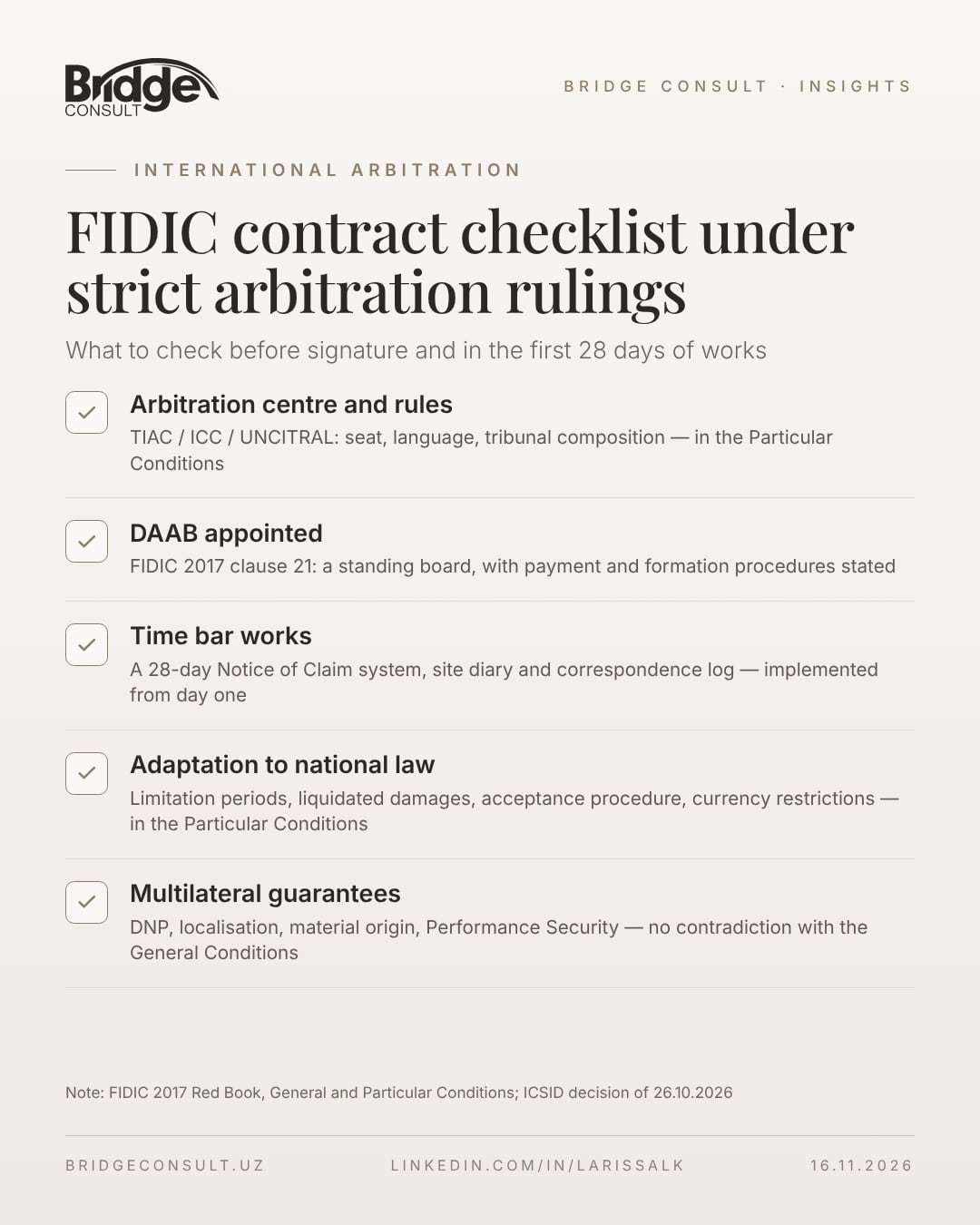
- The arbitration centre and rules are defined (TIAC, ICC or UNCITRAL), with seat, language and composition of the tribunal
- The DAAB is appointed (clause 21, FIDIC 2017) — a standing board, with the payment and formation procedure stated
- The time bar under 20.2 works: a notice system, site diary and correspondence log — implemented from day one
- The Particular Conditions are adapted to national law: limitation periods, liquidated damages, acceptance procedure, currency restrictions
- Delay Damages, Retention Money and Performance Security limits are consistent with the Contract Data
- Multilateral guarantee obligations (DNP, localisation, material origin) are included and do not contradict the General Conditions
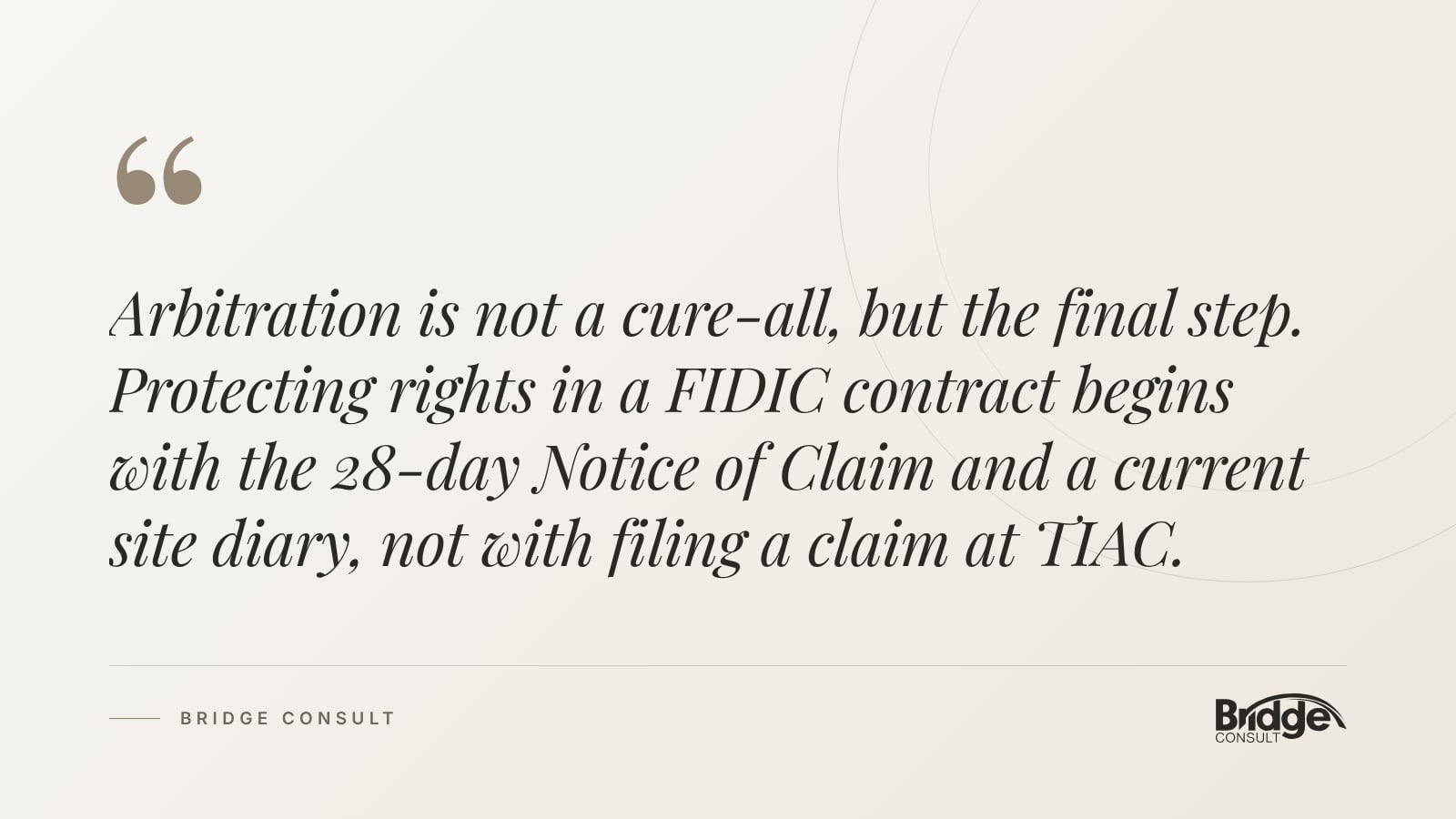
Arbitration is the final step, not the first. What the employer and the contractor do with the site documents and with notices in the first 28 days after an event determines whether they will even reach the DAAB, let alone TIAC or ICC. The ICSID precedent in favour of Uzbekistan is a reason to review your own contracts along this logic, not only through the Bridge Consult FIDIC handbook.
Frequently asked questions
How does the ICSID ruling against Turkish investors affect FIDIC contractors in Uzbekistan?
It confirms that disputes are decided strictly on evidence, with no investment ‘privileges’. For the contractor this means that Notice of Claim, time-bar and contemporary-records discipline become decisive — without them, neither the DAAB nor arbitration will restore lost rights.
Why are TIAC and other local arbitration centres becoming the standard in FIDIC contracts?
Predictability, transparency, local accessibility and the independence of tribunals. In strict legal environments this lowers the cost of financing and increases investor confidence. For public employers it is also a question of transparency. Specific rules and costs are best confirmed in the rules of the chosen centre.
What should a contractor do if the employer delays the handover of documentation?
Within 28 days of becoming aware of the delay, file a Notice of Claim under 20.2.1, record it in the site diary and raise it under 8.4 Advance Warning. At 84 days — a fully elaborated claim with the Extension of Time and cost calculated under the EOT materials.
What risk does carrying national contracting forms into a FIDIC contract create?
Contradictions between the General and Particular Conditions. In strict arbitration and court disputes this is treated as incurable ambiguity — and the risk falls on the party that created it. Adaptation to national law is essential.
Is the DAAB mandatory in FIDIC 2017, or can it be omitted?
Under the 2017 General Conditions the DAAB is a standing body appointed after works begin. Its informal assistance (21.3) and its decision on disputes (21.4) are a standard step before arbitration. The Particular Conditions can modify the mechanism, but most multilateral banks require it to be retained.
Sources and references
- Spot.uz — International arbitration dismisses a group of Turkish investors’ claim against Uzbekistan, 14.11.2026
- Gazeta.uz — In Uzbekistan, power-station capacity is growing, but network wear and tear is hindering reliable energy supply, 15.11.2026
- FIDIC 2017 Red Book, clause 20.2
How Bridge Consult can help
Bridge Consult supports employers and contractors on FIDIC contracts — from reviewing conditions and notices to claims, DAAB proceedings and arbitration. Founder Larissa Belousova is a FIDIC Certified Consulting Engineer and an ADB Accredited Contract Management and Dispute Avoidance Specialist.
Have a question about a live contract? Contact us and we will look at your situation.
Read next

FIDIC Uzbekistan
Expert materials, case studies and event announcements on FIDIC contracts in Central Asia — before they reach the site.