
Variation: What It Means under FIDIC and How to Formalise a Change
A Variation is a change to the scope or character of the Works under a FIDIC contract. We explain who may initiate it, how an instruction differs from a request for proposal, and what a contractor should do when a change is given orally.
 Larissa Belousova
A Variation is a change to the Works under a FIDIC contract: to quantities, quality, levels, sequence or scope. In the 2017 edition Variations are dealt with in Clause 13, and only the Engineer can initiate one, by an instruction or by a request for proposal. Work done “by understanding” without that formality stays at the Contractor’s risk.
In brief: A Variation is a change to the Works which under FIDIC 2017 is initiated either by the Engineer’s instruction (Sub-Clause 13.3.1) or by a request for proposal (Sub-Clause 13.3.2). If the Contractor considers that an instruction is in substance a Variation, it must say so in writing immediately, before starting the work. Without that formality a change is hard to get paid for and harder still to get time for.
Two routes to a Variation
| Instruction (13.3.1) | Request for proposal (13.3.2) |
|---|---|
| Who starts it | The Engineer instructs the change |
| What the Contractor does | Proceeds and submits the price and the effect on time |
| When work starts | At once, on the instruction |
What to do when a change is given orally or “between the lines”
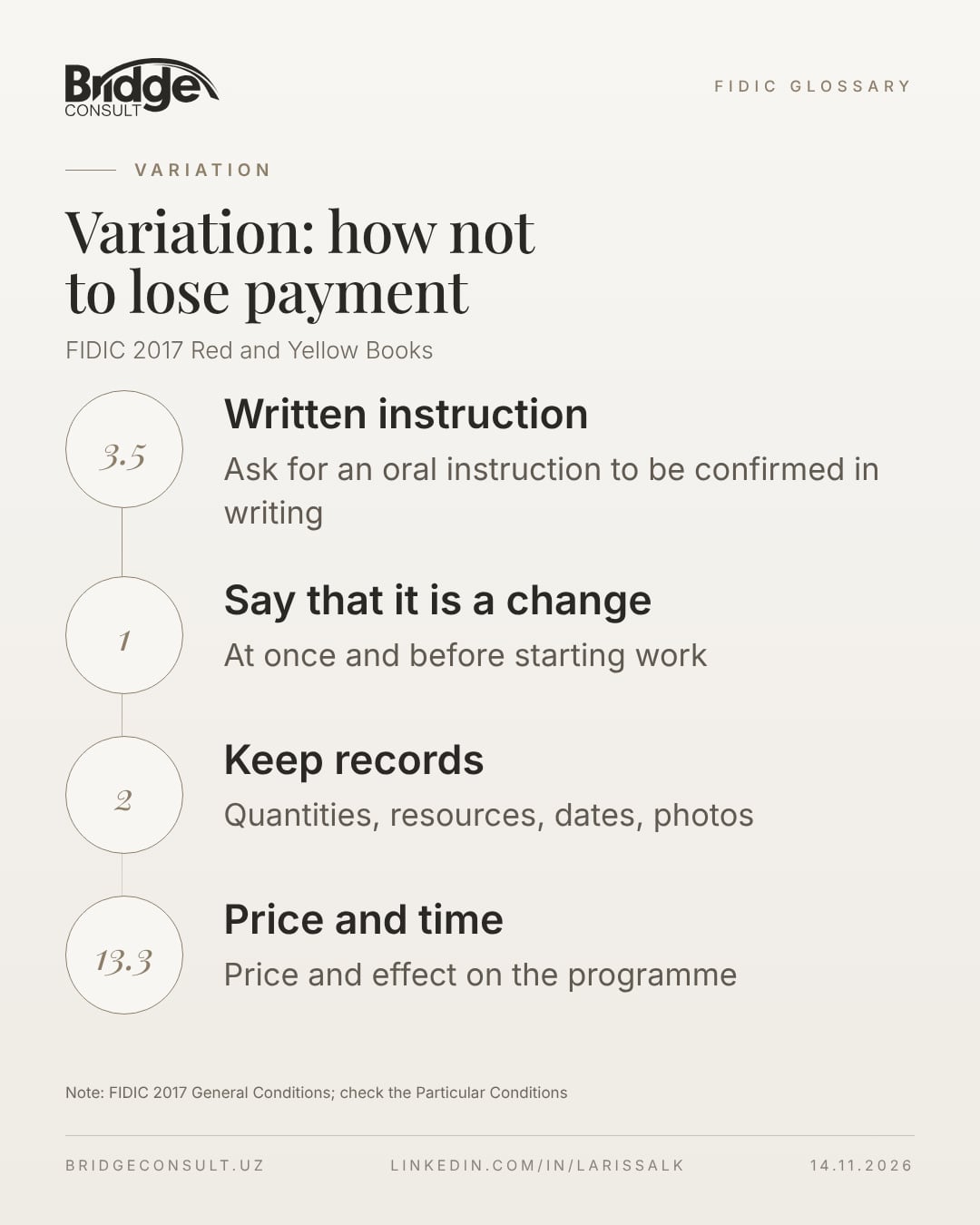
- Ask for a written instruction. Under Sub-Clause 3.5 the Engineer’s instructions are given in writing.
- If you consider the instruction a Variation, tell the Engineer so in writing at once, before starting that work.
- Keep records: quantities, resources, dates, photographs. Without them the price of the change cannot be proved.
- If the change affects time or money and there is no agreement, do not wait: a Notice of Claim is due within 28 days.
Common mistakes
- Work was done at the Employer’s oral request rather than on the Engineer’s instruction.
- The Contractor carried out the change silently and raised it at the end of the project.
- The price of the change was agreed but its effect on the Time for Completion was forgotten.
- Under the Yellow Book a change to the Employer’s Requirements is confused with development of the Contractor’s own design, for which the Contractor is responsible.
Frequently asked questions
Who can instruct a Variation under FIDIC?
Only the Engineer: by an instruction under Sub-Clause 13.3.1 or a request for proposal under Sub-Clause 13.3.2. Instructions from the Employer direct to the Contractor do not have that status unless the contract says otherwise.
Does a Variation give a right to an extension of time?
It may, but not automatically. The effect of the change on the Time for Completion has to be shown and agreed in the way the contract provides.
Sources and references
- FIDIC Red Book 2017, Clause 13
- FIDIC Red Book 2017, Sub-Clauses 13.3.1 and 13.3.2
- FIDIC Red Book 2017, Sub-Clause 3.5
How Bridge Consult can help
Bridge Consult supports employers and contractors on FIDIC contracts — from reviewing conditions and notices to claims, DAAB proceedings and arbitration. Founder Larissa Belousova is a FIDIC Certified Consulting Engineer and an ADB Accredited Contract Management and Dispute Avoidance Specialist.
Have a question about a live contract? Contact us and we will look at your situation.
This term in our articles
- FIDIC DAB vs DAAB: what's the difference, and why it matters not to confuse the abbreviations in your contract
- EPC+F Contracts in Uzbekistan: What to Check Before Agreeing the Price
- IFI Tenders in Uzbekistan and Central Asia: November 2026 Overview
- New Bukhara Airport PPP: Which FIDIC Form, Key Risks and a Pre-Signing Checklist
- Larisa Belousova's arbitrator profile published in the GAR Arbitrator Research Tool
- Full contract administration: BRIDGE Consult has expanded its services for contractors
Other terms
FIDIC Uzbekistan
Expert materials, case studies and event announcements on FIDIC contracts in Central Asia — before they reach the site.