
Contemporaneous Records under FIDIC: Keeping Day-One Records for EOT and Variations
What contemporaneous records mean under FIDIC, where the Contractor's duty to keep current records sits in the Contract, and how to keep them so that a claim for Extension of Time (EOT) and payment of a Variation stands up. The article sets out the minimum data to capture, the 28- and 84-day deadlines, how the records link to the Notice of Claim, and the typical mistakes that cost the Contractor compensation.
 Larissa Belousova
“Contemporaneous” here means “current” – captured at the time the event occurred, not reconstructed from memory months later. Contemporaneous records are the Contractor’s day-by-day account of progress, delays and costs, and they form the evidential base for claiming an Extension of Time (EOT) and pricing a Variation. Without them, even a formally correct Notice of Claim turns into a dispute the Contractor loses for want of evidence.
In brief: Contemporaneous records are the Contractor’s current, day-by-day records, kept during execution and tendered when proving an EOT or a Variation. In FIDIC 2017 they are set out in Sub-Clause 20.2.3 (Contemporaneous records), and a fully detailed claim supported by them is submitted under Sub-Clause 20.2.4 within 84 days. Keep them from day one: date, cause, delay, photos, idle resources. Their absence strikes directly at both time and payment.
What contemporaneous records are, and their role in proving EOT and Variation
Contemporaneous records are the Contractor’s current, running records of execution: events, delays, changes, correspondence and costs. In FIDIC 2017 they are set out in Sub-Clause 20.2.3 of Clause 20 (Claims), and the rule applies in both the Red Book and the Yellow Book. Their central purpose is to turn the Contractor’s verbal case into evidence: these records support the Extension of Time (EOT) under Sub-Clause 8.5 and the pricing of a Variation under Clause 13. Without current records, the Engineer and the DAAB are left with the Contractor’s assertions only, not with facts.
On the role of current records, Larissa Belousova wrote in her channel:
«The key rule: Contemporaneous records turn a position from words into evidence.»
Where the term sits in the Contract: book, edition, sub-clause
The duty to keep current records exists in both the 1999 and 2017 editions. The difference is how it interacts with claims: in 2017, the “same-day record” is complemented by a separate duty under Sub-Clause 8.4 (Advance Warning) – to notify the Engineer in advance of any risk of delay. In 1999 there is no Advance Warning, and the duty to keep current records is worded less strictly, which in practice makes proof harder.
| Book / edition | Duty to keep current records | Link to claims |
|---|---|---|
| FIDIC Red Book 2017 | Sub-Clause 20.2.3 – contemporaneous records | fully detailed claim under 20.2.4 within 84 days; EOT under 8.5 |
| FIDIC Yellow Book 2017 | Sub-Clause 20.2.3 – contemporaneous records | same logic; plus Clauses 5 (Design) and 12 (Testing) |
| FIDIC Red Book 1999 | duty to keep current records (Clause 1, Sub-Clause 1.7) | detailed claim under 20.1 within 42 days |
How it works in practice: minimum content of a record and its link to the Notice of Claim
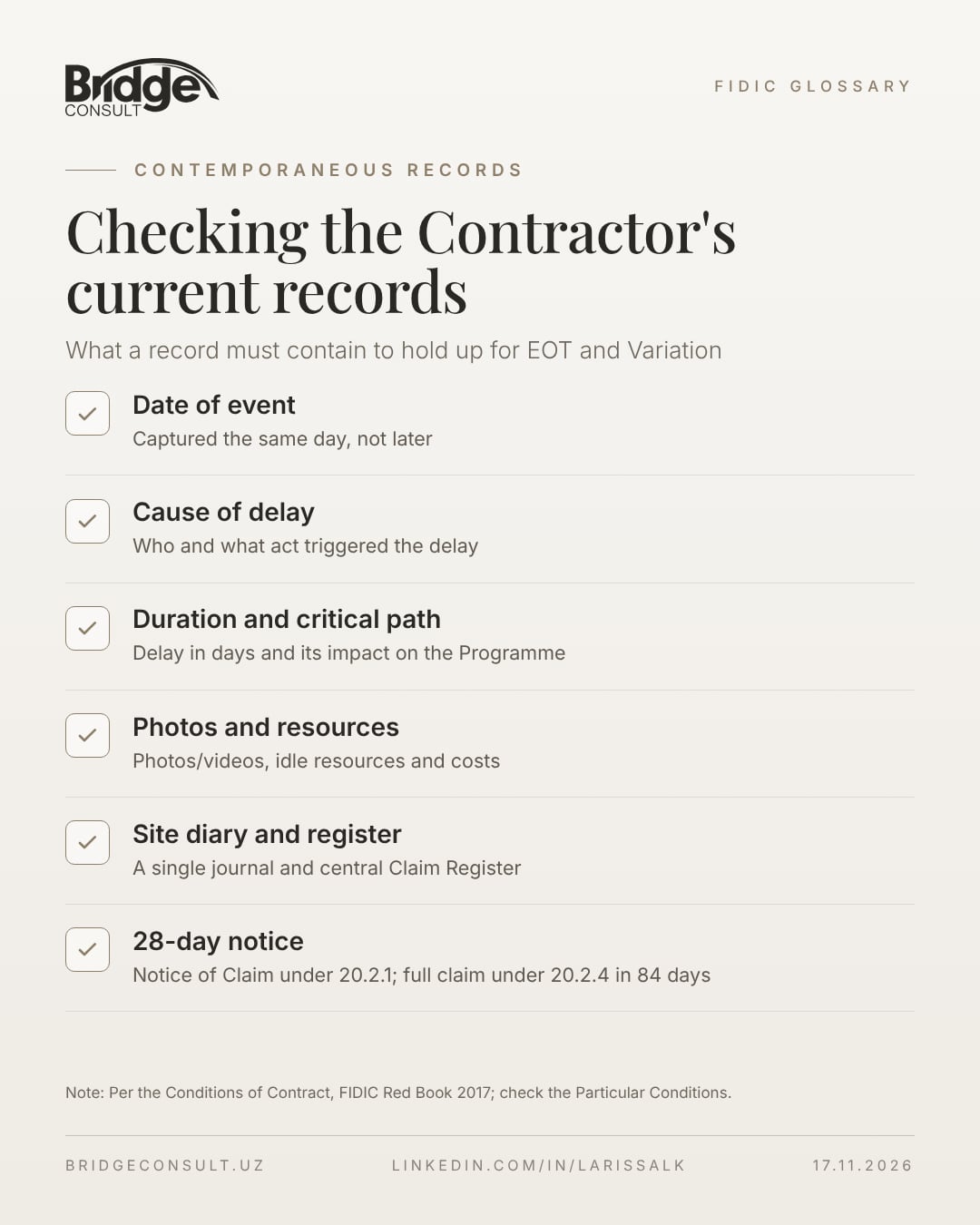
In practice the approach rests on three layers, captured at different stages. The “same-day” layer is the core of the contemporaneous record. The “within 28 days” layer is the formal notification. The “during the delay” layer is the running updates that keep the record current until the fully detailed claim is submitted under Sub-Clause 20.2.4.
Step by step, from the event to the fully detailed claim. All deadlines are per the Conditions of Contract, unless the Particular Conditions amend them.
- On the day of the event: date and time, substance of the event, photos/videos, idle resources, entry in the site diary. This is the foundation of the contemporaneous record.
- Within 28 days – the Notice of Claim under Sub-Clause 20.2.1: send the notification and keep proof of dispatch.
- Within 84 days – the fully detailed claim under Sub-Clause 20.2.4: attach the Programme analysis, the EOT calculation and the costs, all backed by the records.
If these fields are missing, the record is not evidence.
- Date and time of the event, and that it was captured the same day
- Cause: who and what act or event triggered the delay
- The delay in days and its impact on the critical path
- Photographic evidence, idle resources and costs
- Cross-references to correspondence, meeting minutes and the current Programme
Common mistakes that cost the Contractor EOT and payment
Each one weakens the evidential base.
- The record is entered weeks after the event, not on the day – it no longer counts as “current” and will lose to the other party’s data
- No photographic evidence: the delay is proved by numbers alone, without on-site corroboration
- Records do not align with the programme: the EOT calculations do not tie to the critical path
- No site diary or central register: records are scattered across field correspondence and personal notes
- Missing the 28-day Notice of Claim under Sub-Clause 20.2.1, which leaves the contemporaneous records without evidential weight
What contemporaneous records are confused with, and related terms
The term is often confused. “Contemporaneous” does not mean “under current standards” – it means “at the time of the event”. The term is commonly lumped with the broader notion of Project Records (the whole project documentation), and some look for a “Modern records” clause that does not exist in FIDIC. Logically, contemporaneous records are tightly linked to the Notice of Claim (the formal trigger under Sub-Clause 20.2.1) and to the EOT (the claim they prove). Advance Warning under Sub-Clause 8.4 is a separate 2017 duty that runs in parallel, not instead of the records.
Quick reference points.
- Contemporaneous records vs Project Records: current event-level records versus the whole project documentation set
- Contemporaneous records vs Advance Warning (Sub-Clause 8.4): recording the fact of a delay versus flagging a risk early
- Link to EOT: it is the current records that substantiate the Extension of Time under Sub-Clause 8.5
- Link to Variations: the records prove the scope and price of the change under Clause 13
How it works with the Notice of Claim and the DAAB
Contemporaneous records operate together with the Notice of Claim under Sub-Clause 20.2.1: without the 28-day notification, the record by itself does not trigger the claims procedure. In a dispute that reaches the DAAB, the current records are the first document the board or tribunal will ask for. If the records are missing or contradict the programme, the Contractor’s case on EOT and Variation is hard to sustain. Managing a FIDIC contract in practice means building this chain of evidence from day one of the event.
Where contemporaneous records are found in the Contract and on site.
- Sub-Clause 20.2.3: the duty to keep current records
- Sub-Clause 20.2.4: the fully detailed claim within 84 days, to which the records are attached
- Sub-Clause 20.2.1: the 28-day Notice of Claim – without it, the records have no procedural effect
- Sub-Clause 8.4: Advance Warning (2017 only) – the parallel duty to warn of delay risks
- Sub-Clause 8.5: EOT – the Extension of Time that the records support
Frequently asked questions
What are contemporaneous records under FIDIC, in plain terms?
They are the Contractor’s current records, kept throughout execution and captured on the day the event occurs. They form the evidential base for an EOT and for pricing a Variation. Under FIDIC 2017 they are set out in Sub-Clause 20.2.3.
Where in FIDIC 2017 are contemporaneous records set out?
In Sub-Clause 20.2.3 of Clause 20 (Claims) in both the Red Book and the Yellow Book of FIDIC 2017. The fully detailed claim supported by the records is submitted under Sub-Clause 20.2.4 within 84 days. The duty applies per the Conditions of Contract, unless the Particular Conditions amend it.
What must the Contractor do for the records to count for an EOT?
Capture the event the day it happens: date, cause, delay, photos and idle resources. Then issue the Notice of Claim within 28 days under Sub-Clause 20.2.1 and submit the fully detailed claim within 84 days under Sub-Clause 20.2.4.
How do contemporaneous records differ from a Notice of Claim?
The Notice of Claim under Sub-Clause 20.2.1 is the formal notification within 28 days that triggers the procedure. Contemporaneous records under Sub-Clause 20.2.3 are the actual current records that prove the substance of the claim and its quantum.
Sources and references
- FIDIC Red Book 2017, Sub-Clause 20.2.3 (contemporaneous records)
- FIDIC Red Book 2017, Sub-Clause 20.2.4 (fully detailed claim, 84 days)
- FIDIC Red Book 2017, Sub-Clause 20.2.1 (Notice of Claim, 28 days)
- FIDIC Red Book 2017, Sub-Clauses 8.4 (Advance Warning) and 8.5 (EOT)
How Bridge Consult can help
Bridge Consult supports employers and contractors on FIDIC contracts — from reviewing conditions and notices to claims, DAAB proceedings and arbitration. Founder Larissa Belousova is a FIDIC Certified Consulting Engineer and an ADB Accredited Contract Management and Dispute Avoidance Specialist.
Have a question about a live contract? Contact us and we will look at your situation.
This term in our articles
- EPC+F Contracts in Uzbekistan: What to Check Before Agreeing the Price
- International Arbitration Against Turkish Investors: What It Means for FIDIC Contracts
- New Bukhara Airport PPP: Which FIDIC Form, Key Risks and a Pre-Signing Checklist
- EOT: How a Contractor Can Lawfully Extend Time and Avoid Delay Damages
Other terms
FIDIC Uzbekistan
Expert materials, case studies and event announcements on FIDIC contracts in Central Asia — before they reach the site.