

EPC+F Contracts in Uzbekistan: What to Check Before Agreeing the Price
Cabinet of Ministers Decrees No. 583–584 introduce new overhead cost rates and pricing rules for engineering and survey work. In EPC+F, these must be addressed during negotiations: funding source, separate line items for Engineering, Construction and Financing, and a contractual price-adjustment mechanism before signing.
 Larissa Belousova
On 21 October 2026, Cabinet of Ministers Decrees No. 583 and No. 584 were adopted, regulating contractor overhead costs and the pricing of engineering and survey work. For EPC+F projects — design, procurement, construction and financing — these changes must be accounted for during negotiations, not at the time of handover. Below is a practical checklist: which rates apply, how to break down the EPC+F price by element, and which FIDIC clauses to review before the price is agreed.
In brief: From 2027, Decrees No. 583–584 set new contractor overhead indicators (up to 20% of direct costs, 7% profit, 2.5–5% production overhead) and a separate method for valuing engineering and survey work, including designer’s supervision. In EPC+F these cannot simply be absorbed into the bill of quantities: first establish the funding source, show Engineering, Construction and Financing separately, and fix a contractual price-adjustment mechanism in the Particular Conditions.
Context: Decrees No. 583–584 and Why the Question Is Settled at the Negotiation Stage
Decree No. 583 establishes the indicators for preparing design and estimate documentation and for determining the initial value of assets financed from the state budget or from the funds of business entities in which the state holds a 50% or greater stake. Decree No. 584 governs the pricing of engineering and survey work. For EPC+F, where the contractor delivers not only construction but also design and financing, these rules directly affect the price structure and its recovery period. The decrees do not automatically set an additional payment or a saving: they define the calculation method, and the applicability of a specific mechanism and its effect on price are fixed in the contract. If the parties have not agreed the adjustment procedure during negotiations, uncertainty remains — and price disputes in EPC+F almost always arise retrospectively.
On breaking down the EPC+F price by element, Larissa Belousova wrote in her channel:
«Our practical recommendation — show the cost of design, construction, designer's supervision and financing separately: interest, export credit insurance, bank charges. If everything is lumped into one figure, when the estimate is checked it is harder to explain which costs relate to construction and which arise from payment deferral.»
Funding Source as the Primary Filter: Clause 3 of Decree No. 583
Under Decree No. 583, the new indicators apply to assets financed from the state budget or from the funds of business entities with a state share of 50% or more. This is the key filter: the same EPC+F project may be valued under different rules depending on who the employer is and where the money comes from. For directly concluded contracts a separate calculation method applies, via the Shaffof Kurilish system; the method of contract conclusion also influences the breakdown. Before incorporating the percentage indicators into the EPC+F price, three parameters must be determined: who the employer is, the funding source, and the method of contract conclusion — these determine which rates apply.
- Whether the employer is a state body and what the state share in the business entity is — 50% or more, or less.
- Whether the asset is financed from the budget, from the business entity’s funds, or from own/borrowed funds, and how this is reflected in the tender documentation.
- Whether the contract is concluded directly or through a competitive procedure — this determines whether the Shaffof Kurilish calculation applies.
- In which currency and under which mechanism the price is fixed, and how it will be adjusted if the funding source or rate changes.
| Parameter | What to check | Where to anchor in FIDIC |
|---|---|---|
| Funding source | Budget / business entity with 50%+ state share / own funds | Part A — Contract Data, Part B — Special Provisions |
| Method of conclusion | Tender or direct contract (via Shaffof Kurilish) | Particular Conditions, price formation procedure |
| Currency and indexation | Currency, exchange rate, price indexation mechanism | Sub-Clause 13.7 (2017) — Adjustment for Changes in Costs |
Engineering and Survey Work: How the New Basis Changes the Price Breakdown
Within its scope, Decree No. 584 provides for separate recognition of designer’s supervision — 10% of the cost of preparing design and estimate documentation — and a 30% advance payment to the design organisation under contracts for such work. This is a separate line in the price structure, not part of the general construction bill of quantities.
The Decree also provides for separate payment, by agreement of the parties, for additional design work when approved documentation is changed. For EPC+F it is critical to agree in advance which adjustments are already included in the agreed price and which are handled as a Variation with separate calculation. If the boundary is not drawn now, the contractor risks performing part of the work at its own cost, while the employer will face a price claim only after review.
- Engineering: preparation of design and estimate documentation and designer’s supervision (10% under No. 584).
- Procurement: purchase of materials and equipment, including logistics and customs duties.
- Construction: civil engineering works, contractor overhead up to 20% of direct costs, 7% profit (under No. 583, if the budget/business-entity-with-50%+-state-share procedure applies).
- Financing: interest, export credit insurance, bank charges for raising funds.
Key FIDIC Clauses to Check the EPC+F Price Before Agreement
EPC+F is not a FIDIC form, but a transaction structure: the contractor additionally arranges or organises project financing. The contractual basis is usually the FIDIC Silver or Yellow Book with tailored Particular Conditions. Price verification relies on the same General Conditions mechanisms, with the correction that in the Silver Book the Employer’s Representative performs the role of the Engineer. The clause numbers cited below refer to the 2017 Red Book and Silver Book; in the 2017 Yellow Book the numbering and titles of some clauses differ (Clause 5 — Design, Clause 12 — Testing), so verify the numbering against the Yellow Book.
| Price aspect | Clause (2017 edition) | What to check at negotiations |
|---|---|---|
| Scope and price changes | Clause 13 — Changes and Adjustments (Variations) | Which adjustments are within the price and which are handled as a Variation; valuation and indexation mechanism (13.7) |
| Payments and advance | Clause 14 — Price and Payment | Separate treatment of design and construction advances (14.2); interim payment certificate deadlines (14.6–14.7) |
| Commencement, delay and suspension | Clause 8 — Commencement, Delays and Suspension | Programme deadline (8.3); capped Delay Damages (8.8); Advance Warning (8.4) |
| Price and time claims | Clause 20 — Claims and Disputes | Notice of Claim 28-day period (20.2.1); fully substantiated claim 84 days (20.2.4) |
Under Clause 13 it is important to separate ‘adjustments within the price’ from ‘changes requiring a Variation’ with separate calculation. Under Clause 14 — check how the advance for different types of work is refunded and when interim and final payment certificates are issued. Under Clause 8 — agree the cap on Delay Damages and the Extension of Time mechanism. Under Clause 20 — fix the notification deadlines: missing the 28-day window may cost the right to compensation (time bar). If the Particular Conditions have changed a deadline or mechanism, verify the Contract Data and Particular Conditions, not the General Conditions — the Particular Conditions prevail, and the General Conditions periods apply unless the Particular Conditions change them.
Typical Contractor and Employer Risks in the EPC+F Structure
- Passing through inflation and currency factors: in EPC+F with a long construction and financing period, the exchange rate and material costs may move the price; an indexation mechanism (13.7) and a currency-fluctuation provision are needed.
- Unforeseen geotechnical and physical risks: Unforeseen Physical Conditions (4.12) and hidden works; at the design stage these are unrecorded works that later become a claim or a Variation.
- Financing: interest, export credit insurance and bank charges must be visible separately in the price structure, otherwise they are difficult to justify when the estimate is checked.
- Advance and payment delay: where payment is deferred, contractor costs grow; separate accounting of the design and construction advances prevents overlap of refunds.
Practical Check List: 8 Questions Before Signing the Contract and Agreeing the Price
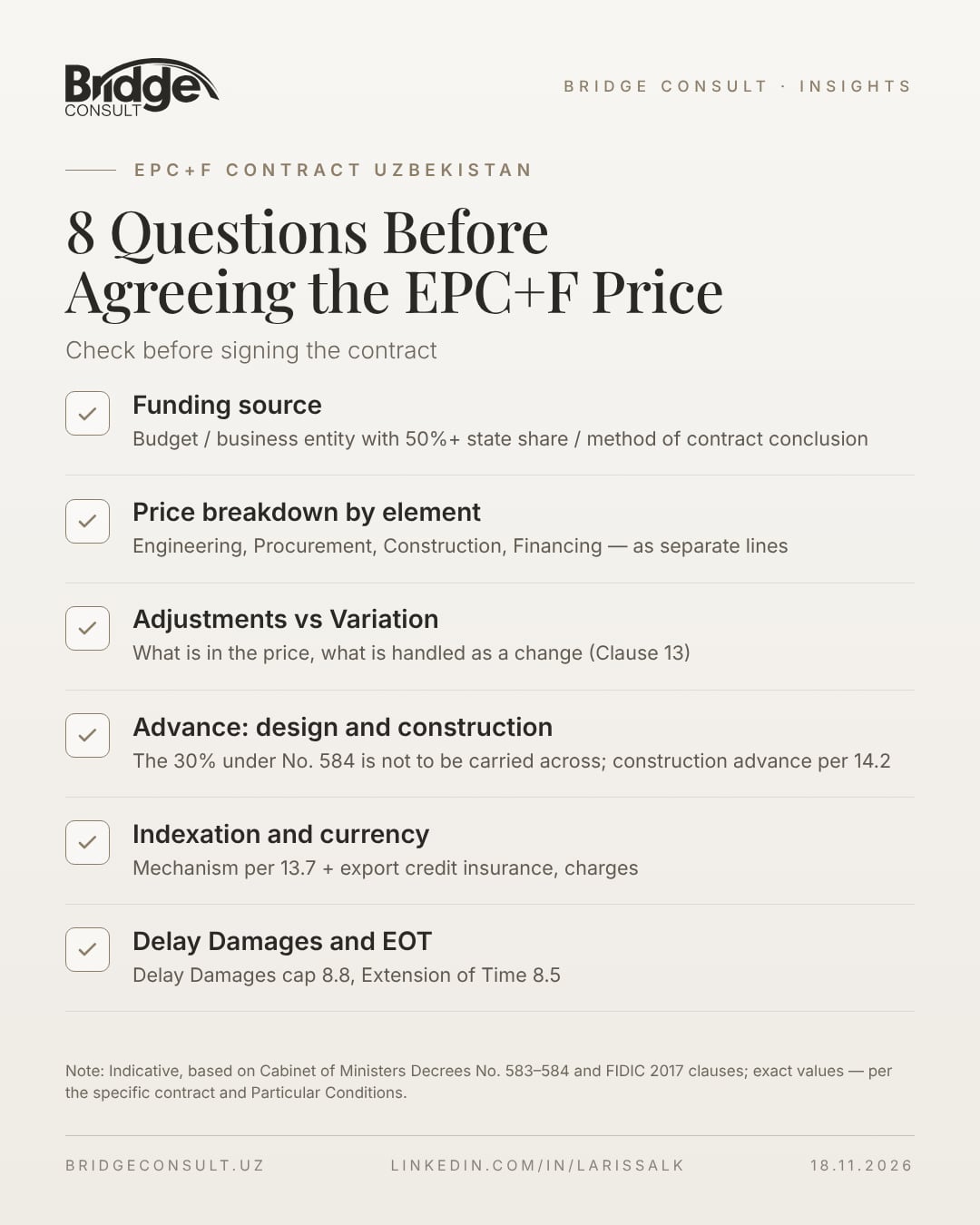
- Identify the employer, the funding source and the method of contract conclusion — this determines which rates under No. 583–584 apply.
- Break down the price by element: Engineering, Procurement, Construction, Financing — each as a separate line.
- Determine which design adjustments are within the price and which are handled as a Variation (Clause 13).
- Check the design advance (30% under No. 584) and the construction advance (14.2) — ensure they are not mixed.
- Agree the indexation and currency-fluctuation mechanism (13.7), including export credit insurance and bank charges.
- Fix the Delay Damages cap (8.8) and the Extension of Time procedure (8.5), accounting for concurrent delays.
- Check the Clause 20 notification deadlines (Notice of Claim — 28 days) and record the DAAB procedure (Clause 21).
- Check the contractual price-adjustment mechanism: applicability of the new rules and the procedure for additional payment/adjustment for existing contracts.
First check the applicability of the new rules to a specific project and the contractual price-adjustment mechanism. The adoption of a Decree does not automatically determine the amount payable to the contractor — the amount and procedure follow from what the parties have fixed in the contract. If the applicability of the new rates is in question, it must be worked through against the specific contract text and Particular Conditions, not pushed into the handover certificate.
Common Errors in the Source Data and How to Avoid Them
- Oral instructions instead of those fixed in the documentation: without a written Notice and up-to-date records (contemporary records), the contractor cannot prove the basis for an Extension of Time or a Variation in a price dispute.
- No site diary and minutes: without current records (20.2.3), a discrepancy on price and time is difficult to substantiate.
- Unrecorded works at the design stage: hidden geotechnical and physical conditions not reflected in the source data later become claims and Variations; build them in at the design stage, not after construction has started.
- Mixing the design and construction advances: the 30% under documentation-preparation contracts cannot be carried over to the entire EPC+F contract.
- A single ‘black-box’ price figure: without a breakdown into Engineering, Construction and Financing, it is hard to explain to auditors which costs relate to construction and which arise from payment deferral.
Show the cost of design, construction, designer’s supervision and financing separately — interest, export credit insurance, bank charges. If everything is lumped into one figure, when the estimate is checked it is harder to explain which costs relate to construction and which arise from payment deferral. A clear breakdown of the source data at the negotiation stage saves months of dispute at handover. For a systematic approach to the contract and to claims, it is useful to review the materials on DAAB and Notice of Claim, and on FIDIC contract support.
Frequently asked questions
What is an EPC+F contract and how does it differ from a standard EPC?
EPC+F is a transaction structure in which the contractor performs design, procurement and construction and additionally arranges or organises project financing. The contractual basis is usually the FIDIC Silver or Yellow Book with tailored Particular Conditions, not a separate FIDIC form.
Which contractor overhead costs does Decree No. 583 introduce?
For assets financed from the state budget or from the funds of business entities in which the state holds a 50% or greater stake, contractor overhead of 20% of direct costs, required profit of 7% and production overhead of 2.5% (5% for mountain, desert and remote areas) are provided for. Whether this procedure applies to your project is determined by the employer, the funding source and the method of contract conclusion.
Can the 30% design-documentation advance be carried over to the entire EPC+F contract?
No. Decree No. 584 provides for a 30% advance under contracts for preparing design documentation within its scope. That advance relates to design and cannot automatically be carried over to the advance for the entire EPC+F contract — in FIDIC the construction advance is regulated separately (Sub-Clause 14.2).
How should the contractor’s operating costs from payment deferral be reflected in the EPC+F price?
Separately within the Financing element: interest, export credit insurance, bank charges. If these costs are lumped into a single figure with the main contract, it will be harder to justify, when the estimate is checked, which expenses relate to construction and which arose from payment deferral.
What is checked under FIDIC before agreeing the EPC+F price?
The separation of price adjustments and Variation (Clause 13), separate accounting of advances and payment certificates (Clause 14), the cap on Delay Damages and Extension of Time (Clause 8), and the notification deadlines and DAAB procedure (Clauses 20–21). All of this must be fixed in the Contract Data and Particular Conditions, not in the General Conditions.
Sources and references
- Cabinet of Ministers Decrees No. 583 and No. 584 of 21.10.2026 (contractor overhead and the pricing of engineering and survey work)
- Larissa Belousova’s post ‘EPC+F in Uzbekistan: What to Check Before Agreeing the Price’, @fidicuzb channel
- FIDIC 2017 Silver Book (EPC/Turnkey) and Yellow Book, Clauses 8, 13, 14, 20, 21 (General Conditions; the Yellow Book has its own numbering)
How Bridge Consult can help
Bridge Consult supports employers and contractors on FIDIC contracts — from reviewing conditions and notices to claims, DAAB proceedings and arbitration. Founder Larissa Belousova is a FIDIC Certified Consulting Engineer and an ADB Accredited Contract Management and Dispute Avoidance Specialist.
Have a question about a live contract? Contact us and we will look at your situation.
Read next


FIDIC Uzbekistan
Expert materials, case studies and event announcements on FIDIC contracts in Central Asia — before they reach the site.