
Delay Damages: What They Are and How They Work under FIDIC
Delay Damages are the pre-agreed sum a contractor pays for each day of late completion. We explain how they are calculated under Sub-Clause 8.8 of FIDIC 2017, where to find the rate and the cap, and how an extension of time affects them.
 Larissa Belousova
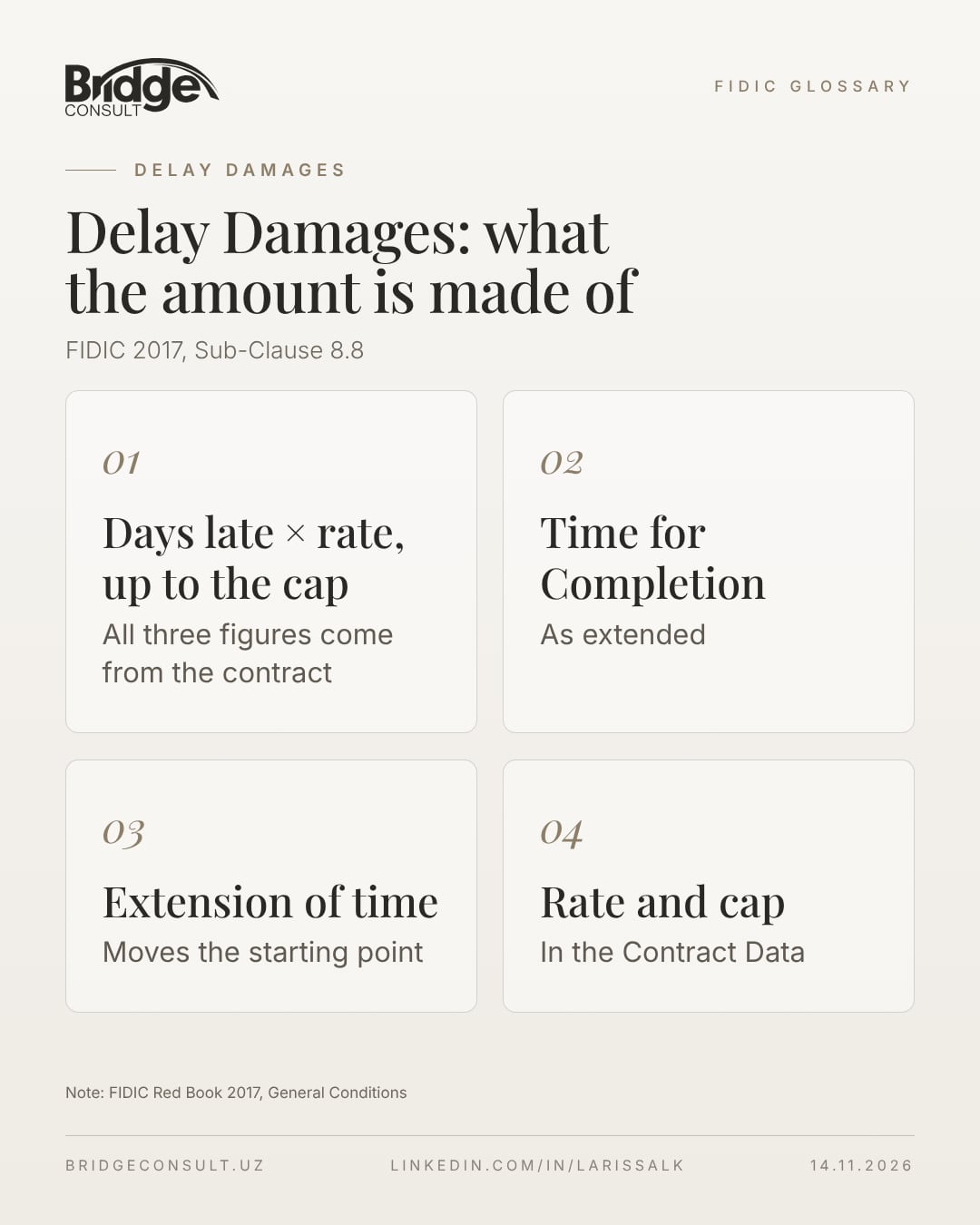
Delay Damages are the amount a contractor pays the Employer for each day by which completion of the Works is late. Under FIDIC the amount is agreed in advance: the daily rate and the overall cap are stated in the Contract Data. In the 2017 edition this is Sub-Clause 8.8.
In brief: Delay Damages are payable under Sub-Clause 8.8 of FIDIC 2017. They accrue for each day between the Time for Completion (as extended) and the actual completion date, at the rate stated in the Contract Data and up to the cap stated there. The better an extension of time is documented, the smaller the period on which the damages run.
How the amount is calculated
- The starting point is the Time for Completion (Sub-Clause 8.2), including extensions under Sub-Clause 8.5.
- The end point is the completion date stated in the Taking-Over Certificate.
- The daily rate and the maximum amount come from the Contract Data.
- The Employer pursues its entitlement through the claims procedure in Clause 20 rather than simply withholding money.
How Delay Damages relate to an extension of time
An extension of time (EOT) moves the date from which delay is counted. A Notice of Claim given in time and a proven effect on the critical path therefore directly reduce the damages. The link is explained in our article on extensions of time and delay damages.
Common mistakes
- The Contractor did not claim an EOT in time and pays damages for delay caused by the Employer.
- The rate or the cap is left blank in the Contract Data and the Parties argue whether damages apply at all.
- Damages are counted from the original Time for Completion, ignoring agreed extensions.
- National law on penalties was not considered when the Particular Conditions were drafted.
Frequently asked questions
Are Delay Damages capped?
Yes. The maximum amount is stated in the Contract Data. If it is not stated, the answer depends on the terms of the particular contract and the governing law.
Can a contractor avoid Delay Damages?
Where the delay is caused by grounds for which the Employer is responsible, the Contractor may claim an extension of time. An agreed extension shortens or removes the period for which damages accrue.
Sources and references
- FIDIC Red Book 2017, Sub-Clause 8.8
- FIDIC Red Book 2017, Sub-Clauses 8.2 and 8.5
How Bridge Consult can help
Bridge Consult supports employers and contractors on FIDIC contracts — from reviewing conditions and notices to claims, DAAB proceedings and arbitration. Founder Larissa Belousova is a FIDIC Certified Consulting Engineer and an ADB Accredited Contract Management and Dispute Avoidance Specialist.
Have a question about a live contract? Contact us and we will look at your situation.
This term in our articles
Other terms
FIDIC Uzbekistan
Expert materials, case studies and event announcements on FIDIC contracts in Central Asia — before they reach the site.