
Engineer’s Determination under Sub-Clause 3.7 of FIDIC
An Engineer’s Determination is the decision by which the Engineer settles a difference between the Parties on a claim or another matter when they have not agreed. We set out the time limits under Sub-Clause 3.7 of the 2017 edition and what to do if you disagree.
 Larissa Belousova
An Engineer’s Determination is the Engineer’s decision on a matter the Parties could not agree: the amount of a claim, an extension of time, the valuation of a Variation. In the FIDIC 2017 edition the procedure is in Sub-Clause 3.7, and the Engineer must act neutrally in it, not as the Employer’s representative.
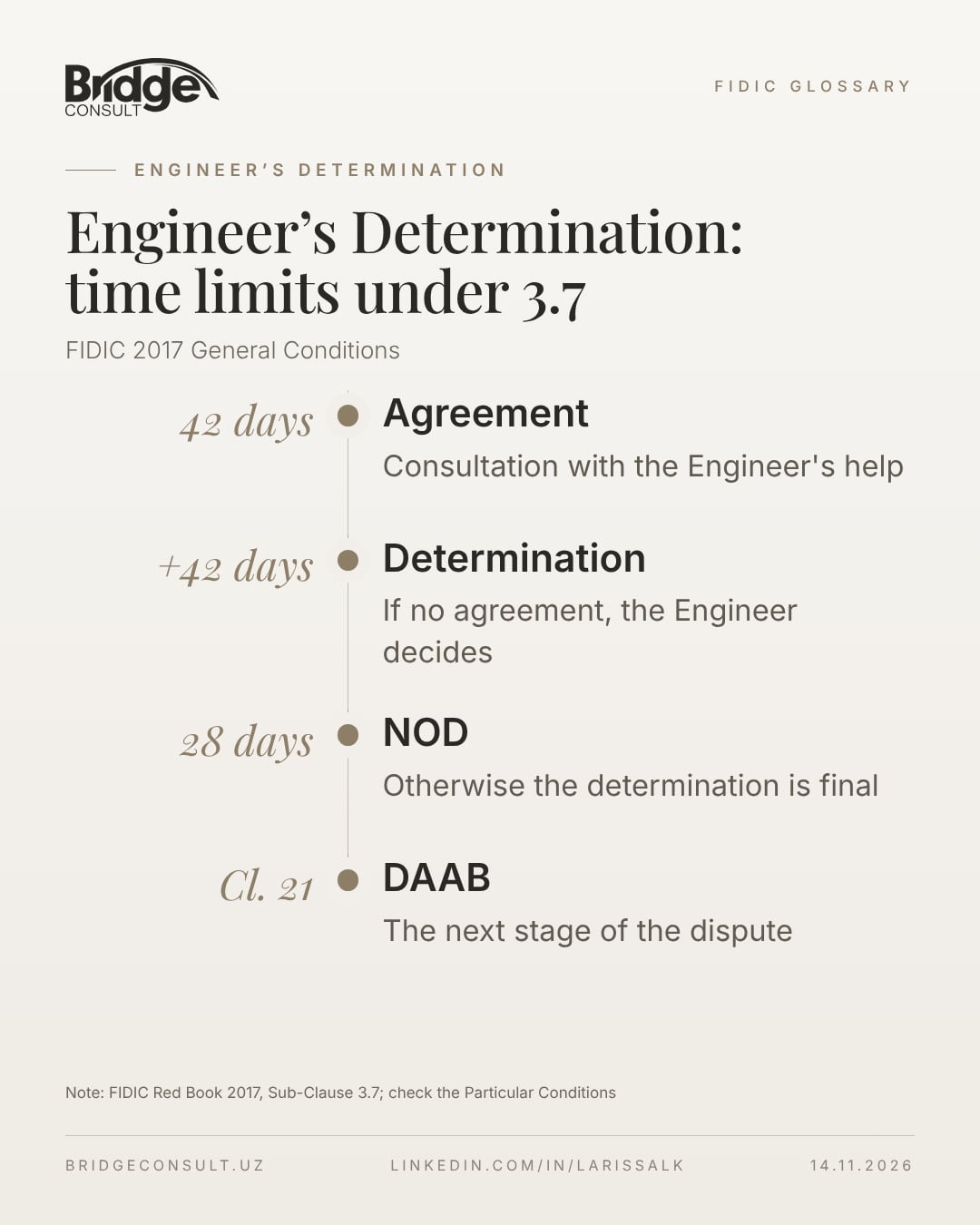
In brief: Under Sub-Clause 3.7 of FIDIC 2017 the Engineer first helps the Parties to agree: 42 days are allowed for agreement. If there is none, the Engineer makes a determination within the following 42 days. A dissatisfied Party gives a Notice of Dissatisfaction within 28 days; otherwise the determination becomes final and binding.
How the Sub-Clause 3.7 procedure runs
- Consultation: the Engineer discusses the matter with both Parties and encourages agreement.
- Agreement: if the Parties agree within 42 days, the Engineer records the agreement.
- Determination: if they do not, the Engineer makes a reasoned determination within the following 42 days.
- Compliance: the Parties give effect to the agreement or determination even if one of them disagrees.
- Dissatisfaction: a NOD is given within 28 days; the dispute may then be referred to the DAAB.
What changed from the 1999 edition
In the 1999 edition determinations are in Sub-Clause 3.5: the Engineer makes a fair determination, but without step-by-step time limits and without a separate notice-of-dissatisfaction regime. The 2017 edition added strict periods and expressly requires the Engineer to be neutral — one of the main differences between the two editions.
Common mistakes
- A Party disagrees with the determination but gives no NOD within 28 days, and loses the chance to dispute it.
- The determination is not complied with “until the dispute is decided”, although it binds at once.
- The Employer tries to dictate the content of the determination to the Engineer.
- A Party holds documents back during consultation, hoping to “save” them for arbitration.
Frequently asked questions
Is an Engineer’s Determination binding?
Yes. The Parties must give effect to it at once. If neither Party gives a NOD within 28 days, it becomes final and binding.
Does the Engineer act for the Employer when making a determination?
No. Under Sub-Clause 3.7 of the 2017 edition the Engineer acts neutrally between the Parties and is not deemed to act for the Employer.
Sources and references
- FIDIC Red Book 2017, Sub-Clause 3.7
- FIDIC Red Book 1999, Sub-Clause 3.5
How Bridge Consult can help
Bridge Consult supports employers and contractors on FIDIC contracts — from reviewing conditions and notices to claims, DAAB proceedings and arbitration. Founder Larissa Belousova is a FIDIC Certified Consulting Engineer and an ADB Accredited Contract Management and Dispute Avoidance Specialist.
Have a question about a live contract? Contact us and we will look at your situation.
This term in our articles
Other terms
FIDIC Uzbekistan
Expert materials, case studies and event announcements on FIDIC contracts in Central Asia — before they reach the site.