
FIDIC DAB vs DAAB: what's the difference, and why it matters not to confuse the abbreviations in your contract
DAB and DAAB describe different procedures: in the FIDIC 1999 edition the Dispute Adjudication Board only resolves disputes, while in the 2017 edition the Dispute Avoidance and Adjudication Board also prevents them. We examine composition, powers, timeframes, and what to do if the abbreviations in a contract have been mixed up.
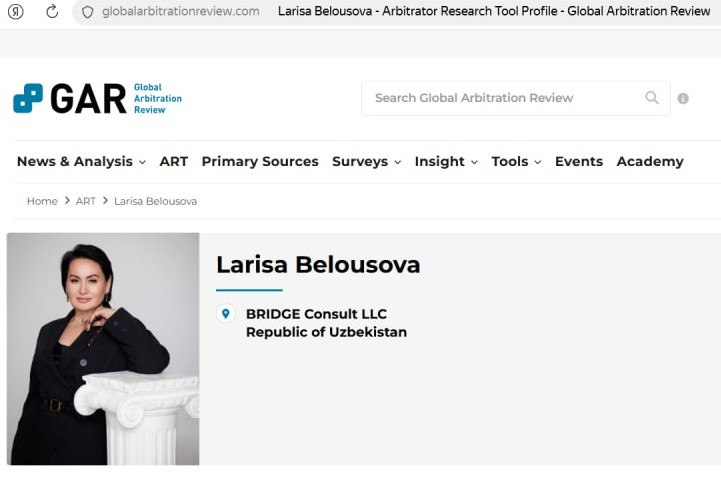
 Larissa Belousova
Search engines regularly get queries like “what is DAB in FIDIC” and “what is DAAB in FIDIC” when the same board is meant — and that’s no coincidence: the two abbreviations really do look alike, but in contracts of different editions they describe different procedures. In the 1999 FIDIC Red Book the board is called the Dispute Adjudication Board (DAB); in the 2017 edition it is the Dispute Avoidance and Adjudication Board (DAAB), and its role is wider: it doesn’t just resolve a dispute, it also helps the parties prevent one.
In this article: what DAB and DAAB are, the specific differences in timeframes and powers, the consequences of a typo in the contract, and a 5-point checklist to review the documentation before signing.
In brief: DAB — the dispute-resolution-only board in FIDIC 1999; DAAB — in FIDIC 2017, with a preventive function: informal assistance to the parties and a standing composition. If a 2017 edition contract says DAB, or a 1999 contract says DAAB, the timeframes and procedures may not line up: check the Particular Conditions and Contract Data.
Why DAB and DAAB get confused: different generations, one function
Both boards are collegiate bodies of specialists that issue an interim, binding decision on a claim unless the parties contest it. The key difference is the contract generation: the DAB operates under the 1999 editions (Red, Yellow, Silver), the DAAB under the 2017. In 1999 the board is brought into the project mainly once a dispute has already arisen; in 2017 it is present on the project continuously from appointment and takes part in preventing disputes — which is why the word avoidance was added to the abbreviation.
Key points in practice:
- In 1999 the DAB in the Red Book is standing; in the Yellow and Silver Books it is ad hoc, formed after a dispute.
- In 2017 the DAAB is standing in all three books; appointed immediately and able to work without a formal dispute.
- In 2017 the board may carry out site visits and consultations to prevent disputes — the 1999 edition has no such function.
- Even within the same book (say, the Silver Book), DAB and DAAB are not the same mechanism: the DAAB has broader powers on working with the parties.
On the move from DAB to DAAB, Larissa Belousova said at Uzbekistan Arbitration Week 2026:
«For over a hundred years FIDIC has been shaping approaches to risk and conflict management in the construction industry. The move from DAB to DAAB was a logical outcome of accumulated experience: any claim left unattended has every chance of growing into a dispute, and any dispute inevitably drives up the project's time and cost.»
The milestone orientation of the DAB: how it fixes dates, and why the DAAB works differently
In 1999 the DAB engages with the project mechanics only through specific milestone events: the parties submit a claim — the board considers it — issues its decision within 84 days — the parties have 28 days to issue a Notice of Dissatisfaction (NOD), after which the decision becomes final and binding, or the matter goes to arbitration. Between milestones the board is silent.
The 2017 DAAB works on a different logic: it is present continuously and may carry out site inspections, meetings and joint consultations with the parties at their joint request. This is a preventive layer: if the Contractor and Employer can’t agree on the interpretation of a scope of works, they can bring the question to the DAAB before it becomes a claim. This lowers the risk of escalation to arbitration.
The practical difference between the milestone approach and the preventive one:
- Milestone (DAB 1999): the board is the “first instance” for an already-arisen claim; between disputes it does not operate.
- Preventive (DAAB 2017): the board is the “first filter”, where a question is brought before it grows into a Notice of Claim.
- For Employers: the preventive function cuts legal costs and the risk of a dispute escalating to arbitration.
- For Contractors: the chance to discuss a disputed position before it becomes a formal claim with strict deadlines.
Practical differences: composition, powers, timeframes and appeals
| Parameter | DAB — 1999 | DAAB — 2017 |
|---|---|---|
| Article | Article 20 (20.2–20.4 DAB), all three 1999 books | Article 21 (DAAB), all three 2017 books |
| Function | Dispute resolution | Prevention and resolution of disputes |
| Composition | 1 or 3 members (per Particular Conditions) | 1 or 3 members (per Particular Conditions) |
| Timeframe for dispute decision | 84 days | 84 days |
| Notice of Dissatisfaction | 28 days (20.4) | 28 days (21.4) |
| Amicable settlement | 56 days (20.5) | 28 days (21.5) |
A critical difference in timeframes: in the 1999 edition the parties have 56 days after the NOD for amicable settlement; in the 2017 edition — only 28 days. That’s not a trivial matter: if a project with a 2017 board automatically applies the 1999 timeframes, the parties risk missing the window and losing the chance to settle the dispute amicably.
What else changes between generations:
- Integration with the Notice of Dissatisfaction procedure: in 2017 the NOD is issued within 28 days of the Engineer’s determination; in 1999 there is no separate NOD mechanism in clause 3.5 — the structure of the consultations is different.
- In 2017 the board may carry out joint consultations of the parties at their request (Article 21.3); the 1999 edition has no such function.
- In 1999 the Contractor and Employer have different mechanisms for submitting claims (2.5 and 20.1); in 2017 both submit under 20.2 — this levels the playing field.
- Timeframe for a fully documented claim: in 1999 — 42 days; in 2017 — 84 days (20.2.4).
A common mistake: confusing the abbreviations in the contract documentation, and the consequences
The most common scenario: the Contractor took a 1999 template with DAB, the Employer a 2017 one with DAAB, and nowhere was it specified that the Particular Conditions determine which edition and which board apply. The result: at the meeting the parties name different boards, and the timeframes for the NOD, amicable settlement and the move to arbitration don’t match up in anyone’s head.
What happens legally when the abbreviation is mixed up:
- Determining edition: the board and its procedures are always taken from the edition that the Agreement, Letter of Acceptance and Contract Data reference. The abbreviations in preambles or appendices have no legal force if they contradict the Particular Conditions.
- Timeframe risk: the parties start counting the NOD as 28 or 56 days without knowing which edition “counts”.
- Challenge risk: if the board issues a decision and one party assumed 1999 applies while the other assumed 2017, the decision may be challenged in arbitration due to a misunderstanding of jurisdiction and powers.
- Missed Notice of Claim risk: if the Contractor knows of a delay but doesn’t understand whether they have a DAB or a DAAB, they may fail to issue the notice on time and lose the right (under 20.1 in 1999 / under 20.2 in 2017).
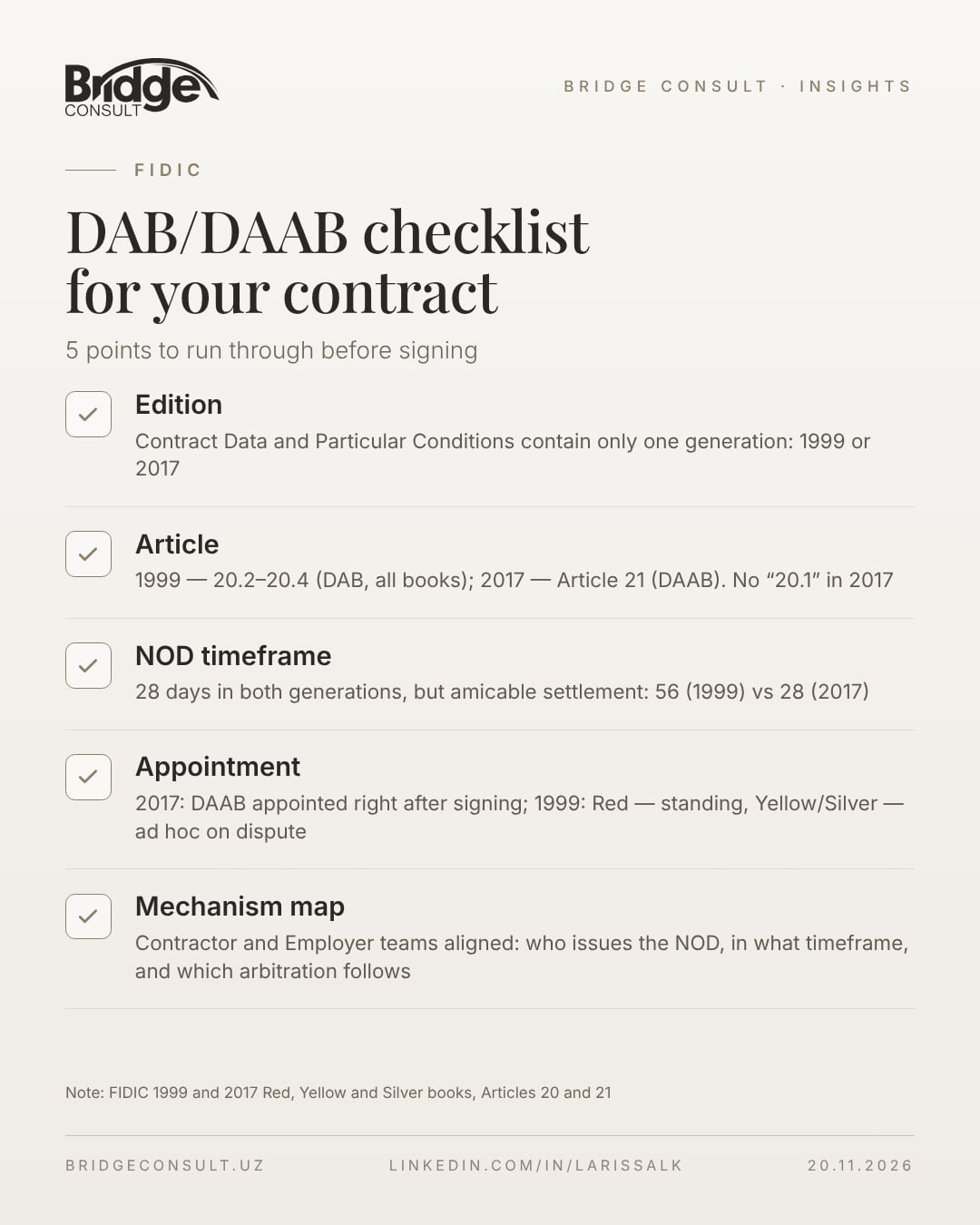
Checklist: 5 points to verify correct use of DAB/DAAB in your contract
-
- Verify the edition: the Contract Data and the article on the board should contain only one generation — 1999 or 2017. If both appear — that’s a red flag.
-
- Check the article number: in 1999 the board is described in Article 20 (20.2–20.4, DAB) in all three books; in 2017 — in Article 21 (DAAB). If a 2017 contract says Article 20 for the board, that’s an error requiring a correction of the Particular Conditions (in 2017 Article 20 is claims).
-
- Count the NOD timeframes: in 1999 — 28 days, in 2017 — also 28, but the amicable settlement in 2017 is shorter — 28, versus 56 in 1999. Make sure the Particular Conditions text states exactly the timeframes you understand.
-
- Check whether the board has been appointed: in 2017 the DAAB must be appointed immediately after signing; in 1999 the DAB in the Red Book is standing, while in the Yellow and Silver it is ad hoc, appointed only on a dispute. If you have 2017 and the board hasn’t been appointed — that’s an administration gap.
-
- Run an internal workshop: the Contractor, Employer and lawyers should agree a single “contract map” of the boards: who, in what timeframe, through which mechanism issues the NOD, and which arbitration the matter goes to after the NOD.
Additionally: if your contract is an EPC+F with a multilateral financial institution (MFI), check not only the FIDIC form but also the Particular Conditions of the specific institution. They may change the NOD timeframes and the board’s appointment procedure (for example, the board may be appointed by the MFI itself rather than by agreement of the parties). This is a typical zone where the Contractor loses time and money through mismatch.
How not to miss the preventive function of the DAAB in your work
If your project has a 2017 DAAB, you have a tool that reduces the number of arbitrations. Don’t wait for a claim — at any stage where the parties can’t agree on the interpretation of a scope of works or a variation, submit the question for a joint consultation to the board at both parties’ request. It’s cheaper than a formal Notice of Claim, and it preserves the working relationship.
Typical triggers when it makes sense to go to the DAAB:
- The Engineer and the Contractor disagree on the interpretation of a section of the design documentation or a variation.
- Grounds for an Extension of Time arise, but the Employer doesn’t give a clear answer.
- A gap in the Particular Conditions or a contradiction between sections of the contract documentation.
- A disputed position on a Variation or Extension of Time (EOT) isn’t closed within the set timeframe.
And finally: if your project is financed by an international financial institution (ADB, World Bank, EBRD, OPEC Fund), the board may be appointed by the MFI itself, and the timeframes and powers may differ from standard FIDIC. Before signing, cross-check the Particular Conditions of the specific bank — that’s where the most time gets lost. Full FIDIC contract support, including working with the DAAB and dispute resolution, is one of Bridge Consult’s services.
Frequently asked questions
DAB and DAAB — what’s the difference in FIDIC?
DAB is the dispute-resolution-only board in the 1999 edition. DAAB is in the 2017 edition, with a preventive function: the board is continuously present on the project and helps the parties before the question becomes a dispute. The full breakdown is in this article and in the DAAB glossary.
FIDIC DAB — what does it mean?
DAB (Dispute Adjudication Board) — a collegiate body of one or three specialists that issues a binding decision on a dispute between the parties in FIDIC 1999. In the 2017 edition the board is called DAAB and has a preventive role.
DAAB and DAB — difference in FIDIC timeframes?
The decision timeframe for a dispute in both generations is 84 days, the NOD is 28 days. The amicable settlement timeframe differs: 56 days in 1999, 28 days in 2017. Also, in 2017 the board may carry out joint consultations and inspections; in 1999 it can’t.
What is a dispute adjudication board and a dispute avoidance board?
Dispute Adjudication Board (DAB) — the dispute-resolution board in FIDIC 1999. Dispute Avoidance and Adjudication Board (DAAB) — the board for preventing and resolving disputes in FIDIC 2017. The difference is the preventive function and the standing composition.
How do I check which board applies in my contract?
Cross-check the Contract Data and the Particular Conditions: they specify the edition (1999 or 2017) and the article number (20 or 21). If both abbreviations appear in the text — that’s an error requiring a written record before signing.
Sources and references
- FIDIC 1999 Red Book, Article 20 (DAB)
- FIDIC 2017 Red Book, Article 21 (DAAB)
- FIDIC 2017 Yellow and Silver Books, Article 21 (DAAB)
How Bridge Consult can help
Bridge Consult supports employers and contractors on FIDIC contracts — from reviewing conditions and notices to claims, DAAB proceedings and arbitration. Founder Larissa Belousova is a FIDIC Certified Consulting Engineer and an ADB Accredited Contract Management and Dispute Avoidance Specialist.
Have a question about a live contract? Contact us and we will look at your situation.
Read next

FIDIC Uzbekistan
Expert materials, case studies and event announcements on FIDIC contracts in Central Asia — before they reach the site.