
New Bukhara Airport PPP: Which FIDIC Form, Key Risks and a Pre-Signing Checklist
The Limak and HBK consortium has won the tender for New Bukhara International Airport under a BTO model. We look at which FIDIC form the deal is likely to use, how risk will be split between the private partner, the state and the Engineer, and what to check in the documents before signing.
 Larissa Belousova
New Bukhara International Airport will be built by a consortium of Turkey’s Limak İnşaat and Qatar’s Hamad Bin Khalid Contracting under a BTO model with a 23-year agreement. For the region’s contracting market, the key point is that the project will rest on a package of contracts rather than a single construction contract: a PPP agreement, an EPC contract for the terminal and an operating agreement. That package, more than the announcement of the winner, will decide who pays for delays and rework.
Below we look at which FIDIC form is most likely to be used, where responsibility divides between the private partner, the state as Employer for the airfield, and the Engineer, and what the parties should check while the agreement is still unsigned.
In brief: The tender for New Bukhara International Airport has been won by a consortium of Limak İnşaat and HBK Contracting. Next comes a 23-year PPP agreement under a BTO model, in which the private partner builds the terminal and the state is responsible for the runway and apron. The main contractual risks are the interface between the two scopes, ground conditions and utility diversions, a programme driven by the presidential deadline of September 2027, and an arbitration clause that will be settled before signing, not after.
What we know: the client, the winning consortium and project status
On 12 November the state-owned company Uzbekistan Airports announced the conclusion of the tender for the construction and operation of New Bukhara International Airport. The winner is a consortium of Turkey’s Limak İnşaat Sanayi ve Ticaret A.Ş. and Qatar’s Hamad Bin Khalid Contracting Company W.L.L., which will take part in a joint project to build and operate the airport.
The deal is structured as a public-private partnership under a BTO model (build, transfer, operate) rather than a construction contract: the private partner builds and then operates the facility, which ultimately passes to the state. A PPP agreement with a term of 23 years is expected, including a construction period of up to three years.
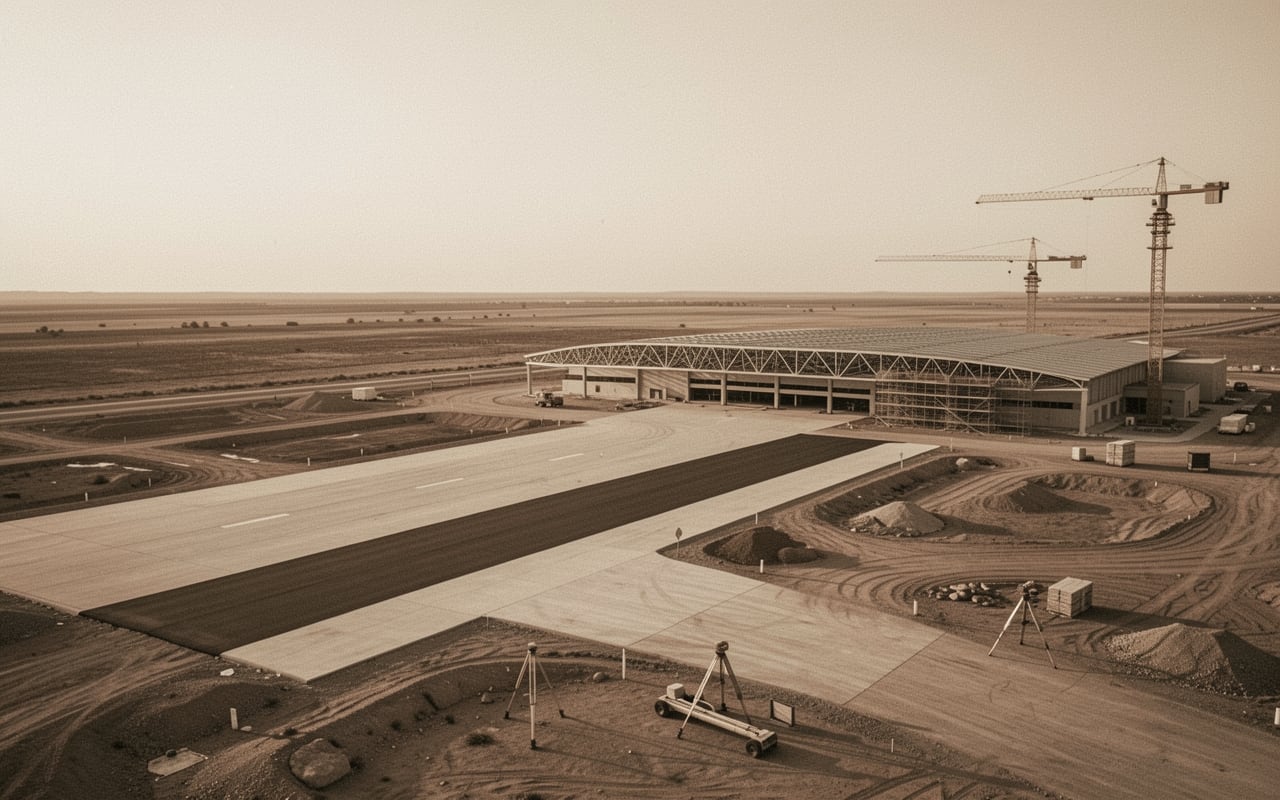
The scopes have been divided firmly from the outset. The private partner will build a passenger terminal with a capacity of 1,200 passengers per hour, the station forecourt, car parks and associated infrastructure. The public partner is responsible for building and operating the airfield complex, namely the runway and apron.
Background: the tender opened on 12 March and ran in two stages, a request for qualifications followed by a request for proposals, with bids from six international companies shortlisted at the first stage. The construction plans were first presented in May 2024 with a preliminary estimate of $226m; by early November 2026 the cost had risen to $300m. A site of 370 ha outside Bukhara has been allocated, the 3.3 km runway is to accommodate all aircraft types, and a 23.8 km road is being built between the airport and the city, including 2.7 km of new alignment.
- The text of the PPP agreement and the concession form, including its origin: a government-drafted document, an adapted FIDIC form or a document based on multilateral development bank standards.
- The governing law, the seat of arbitration and whether there will be a standing DAAB.
- The source and structure of financing: the consortium’s own equity, development bank loans or export credit agency support.
- How risks are allocated between the parties and who will act as the Engineer.
- The signing date and the start date of the works, although the head of state has instructed that the complex be completed by September 2027.
Why this is more than another tender: 23 years, two employers and an interface risk
A 23-year concession means the winner judges the project on its whole-life cost, not on the construction estimate. It will be fixing any defect in the terminal’s concrete or roofing at its own expense for two decades, and that changes its negotiating position on quality and specifications considerably.
The second feature is that the project effectively has two owners: the private partner on the terminal and the state on the airfield. The runway, apron, airfield lighting and the 23.8 km access road sit outside the concessionaire’s contract, yet the terminal cannot open without them. The classic interface risk here arises from a mismatch between two construction programmes, not from an accident.
The contractual architecture of a deal like this usually involves several documents. At the top is the PPP agreement with the state, covering rights, tariffs, term, guarantees and the procedure for handing back the asset. Beneath it sits an EPC or design-build contract for the terminal, which is where the FIDIC form comes in. Separately there is an airport operating agreement and, if the project is debt-financed, a direct agreement with the lenders giving them step-in rights before termination.
The timetable also needs checking. A construction period of up to three years and the instruction to complete the complex by September 2027 do not sit well together: if the agreement is signed at the end of 2026, three years pushes completion out to late 2029. Either the Contract Data will state a different date, or the programme will be compressed through early site access and parallel design, which gives the contractor a different risk profile.
Which FIDIC form will apply: Silver Book vs Yellow and Red Books
There will not be a single form for the whole airport. For the airfield, where the Employer carries out the design, the FIDIC Red Book is the logical choice: the Employer provides the drawings and specification, payment is by remeasurement and the risk of design errors stays with the Employer. The terminal, which the private partner designs itself with 23 years of operation in mind, is closer to the Yellow Book or an EPC model.
The Employer’s temptation is easy to understand: transfer as much risk as possible to the contractor under the Silver Book and secure a fixed price. But in the Silver Book the Engineer is replaced by the Employer’s Representative, and the familiar mechanisms of neutral contract administration work differently. In a project where the state is at once a party to the PPP agreement, the regulator and the owner of the airfield, this creates an imbalance: the contractor will find it harder to obtain an impartial determination on a disputed variation.
| Project component | Likely form of contract | What it changes |
|---|---|---|
| Terminal, car parks, station forecourt | Yellow Book 2017 or EPC contract | The contractor is responsible for design and for the works being fit for operation |
| Airfield: runway, apron | Red Book 2017 | Employer's design, payment by remeasurement, design risk with the Employer |
| Airport operation | O&M agreement, not FIDIC | KPIs, tariffs, handover of the asset to the state after 23 years |
| Financing and security | Direct agreement, guarantees | The lender gains step-in rights before the agreement is terminated |
The practical conclusion for the Employer is that the choice of form is a question of price, not preference. The more risk is transferred to the contractor, the higher the premium in the bid price and the lower the chance that local subcontractors can meet the requirements. How to choose between the editions is covered in FIDIC Red Book vs Yellow Book: how to choose the right form of contract.
Risks that will drive the price: ground conditions, utilities, permits, currency
A 370 ha site outside Bukhara is almost certain to contain things the drawings do not show: weak soils, groundwater, old services and utilities that must be diverted before earthworks begin. Under the General Conditions of the 2017 Red and Yellow Books, unforeseeable physical conditions are governed by Sub-Clause 4.12, which applies only where the contractor genuinely could not have foreseen them from the site investigation data. Under an EPC model, unless the Particular Conditions say otherwise, this risk passes almost entirely to the contractor.
- Land and access. Who hands over the site, in what condition, what counts as access, and when time starts to run after the Notice of the Commencement Date under Sub-Clause 8.1.
- Utility diversions and demolition. In a PPP structure this is typically the state’s obligation, but wording such as ‘provide the conditions’ without deadlines becomes a source of claims.
- Permits and certification. An airfield requires approvals for height restrictions, flight safety zones and commissioning; the contract must state plainly who obtains them and by when.
- Currency and indexation. If costs are incurred in foreign currency while tariffs and payments are in soums, the exchange rate and the indexation formula under Sub-Clause 13.7 must be set out in the Contract Data; otherwise a dispute over compensation is inevitable.
- Change in Laws. Sub-Clause 13.6 of the 2017 edition provides a compensation mechanism, but only if the Particular Conditions are worded correctly and address the applicable national law.
- Local content. If requirements for a share of local subcontractors and materials are introduced, they must be measurable and verifiable, not a statement of intent in the preamble.
Pace is a separate issue. An Employer racing towards September 2027 tends to accept a compressed schedule without a realistic programme of works. Under Sub-Clause 8.3 of the 2017 edition, the contractor submits the initial programme within 28 days of the Notice of the Commencement Date, and the Engineer has 21 days to review it. If the programme is unrealistic from the start, any later dispute over an Extension of Time will turn on whose programme was wrong rather than on the facts.
Disputes and how to prevent them: DAAB, governing law and the Obuzlar case
On 13 November the Ministry of Justice announced that on 26 October an ICSID tribunal had dismissed all claims brought against Uzbekistan by three Turkish nationals and the company Obuzlar Gıda. The request was registered on 4 June 2021, the proceedings lasted more than five years, and the hearing on the merits took place in Washington on 1–10 July 2024. The state was represented by the Ministry of Justice and Curtis, Mallet-Prevost, Colt & Mosle. The dispute concerned a business in the food industry and was based on a 1992 bilateral investment treaty.
The public materials do not show which measures were challenged or how much was claimed, so it would be wrong to conclude that investors always lose: this is a single case with its own circumstances. It does, however, send one clear signal. The state is prepared to go all the way to an award and to win where claims are poorly supported by documents.
This is the practical case for a standing DAAB under the 2017 edition: the board serves the project throughout and deals with disagreements while they are still cheap to resolve. Under Clause 21, a party dissatisfied with a DAAB decision has 28 days to give a Notice of Dissatisfaction; otherwise the decision becomes final and binding. For a foreign investor, this is exactly the tool that keeps a terminal–airfield interface dispute from ending up in arbitration five years later. We explain how it works in What a DAAB is in FIDIC contracts and why your project needs one.
The typical disputes on projects like this are predictable: late handover of the site; late drawings and instructions; unagreed changes in scope; concurrent delay by two contractors on the same facility; refusal of an Extension of Time because the 28-day Notice of Claim under Sub-Clause 20.2 was missed; and, finally, disputes over governing law where national rules restrict contractual mechanisms.
Pre-signing checklist for the Employer, Contractor and Engineer
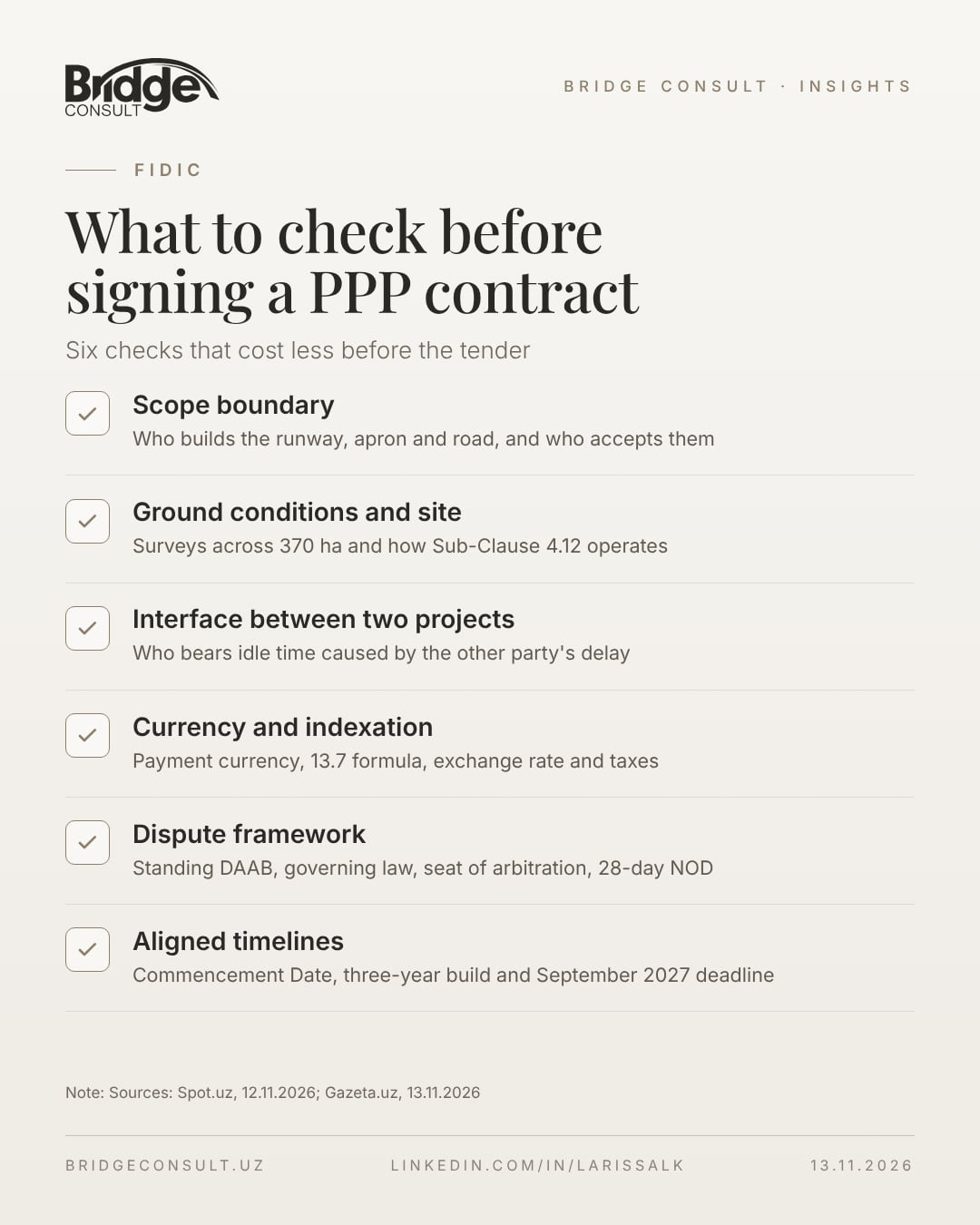
- Fix the scope boundary. One document listing what the private partner builds, what the state builds, and who hands completed facilities to whom and when. No room for double interpretation.
- Check that the dates align. Compare the signing date, the Commencement Date under Sub-Clause 8.1, the construction period and the external deadline; record any discrepancy in the Contract Data, not in meeting minutes.
- Audit the risks. Site investigation, utilities, permits, the currency clause and indexation under Sub-Clause 13.7: for each item, either the risk sits with the Employer or it is priced into the bid.
- Set out the regime for notices and records. The form of Notice, the procedure for contemporary records under Sub-Clause 20.2.3 and site diary requirements should be in place before the first week on site, not after the first dispute.
- Assemble the dispute resolution framework. A standing DAAB, its membership and timescales, the governing law, the seat of arbitration and the 28-day NOD rule.
- Check the local supply chain. Subcontract terms on payment, security and local content requirements, with risks passed down without gaps against the main contract.
The Employer should decide early who will act as its Engineer and whether that Engineer will be independent of the PPP structure. The Contractor should price not only construction but also two decades of terminal maintenance. The Engineer should make sure the Particular Conditions have not turned it into the Employer’s representative in all but name. Experience shows that where these three roles are not kept separate, disputes begin at mobilisation. The full scope of this work is described in FIDIC contract administration support for contractors and employers.
What comes next: a $232bn economy, a project pipeline and contract documents
Bukhara airport is part of a wider wave of investment rather than a one-off project. Uzbekistan’s economy is expected to grow by at least 8% in 2026, and for 2027 the forecast is 7% growth and GDP of $232bn, with inflation falling to 6% and the budget deficit kept within 3% of GDP. The target for 2027 is to attract $65bn in foreign investment.
The draft 2027 budget sets revenue at 416 trillion soums and expenditure at 464 trillion soums, with around 176 trillion soums allocated to education and healthcare and a further 70 trillion soums to infrastructure in the regions and mahallas. There is also a separate task to pilot a digital system for monitoring budget spending on construction projects in the investment programme.
For the contracting market this means two things. First, Employers will be audited not only on deadlines but on the traceability of every soum, so the quality of payment certificates, measurements and supporting documents will be scrutinised rather than treated as a formality. Second, the project pipeline is long, and documents prepared in a hurry will cost more than usual: reworking the Particular Conditions during delivery costs many times more than careful preparation before the tender.
Until the Bukhara agreement is signed, the parties have a rare advantage: time. It is worth spending it on an audit of the Contract Data, checking the chosen form against the actual allocation of risk, and training the project team to handle notices and records. Those skills, rather than a well-turned phrase in the preamble, decide the outcome of the very first disagreement.
Frequently asked questions
Which FIDIC contract is used for airport construction in Uzbekistan?
There is no single form. The terminal, designed by the private partner, usually goes under the Yellow Book or an EPC contract, while the airfield, designed by the Employer, goes under the Red Book. In a PPP structure, FIDIC sits within the partnership agreement rather than replacing it.
Who won the tender for the new Bukhara airport?
A consortium of Turkey’s Limak İnşaat Sanayi ve Ticaret A.Ş. and Qatar’s Hamad Bin Khalid Contracting Company W.L.L. The result was announced by the state-owned Uzbekistan Airports on 12 November 2026; the next step is a 23-year PPP agreement under a BTO model.
What is the BTO model and how does it differ from a standard construction contract?
BTO stands for build, transfer, operate: the private partner builds the facility, operates it and then hands it over to the state. Unlike a contractor, the partner is responsible for the facility for decades, so it assesses whole-life cost rather than the construction estimate.
Why do terminal and airfield disputes arise on airport projects?
The terminal is built by the private partner, while the runway, apron and access road are built by the state. If one project falls behind, the other cannot bring its facility into operation, and a dispute follows over whose delay caused the idle time. That is why the scope boundary and interfaces are fixed before signing.
What did the ICSID ruling in the Turkish investors’ case against Uzbekistan show?
On 26 October 2026 the tribunal dismissed all of the claimants’ claims in a case registered in 2021. The proceedings took more than five years, and that length alone is an argument for a standing DAAB and early resolution of disagreements on the project.
Sources and references
- Spot – Uzbekistan Business News: ‘New Bukhara airport to be built by companies from Turkey and Qatar’
- Gazeta.uz: ‘International arbitration dismisses Turkish investors’ claims against Uzbekistan’
- Spot – Uzbekistan Business News: ‘Uzbekistan’s economy expected to grow 7% in 2027 to $232bn’
- FIDIC Red Book 2017, Sub-Clauses 4.12, 8.1, 13.7, 20.2
- FIDIC Yellow Book 2017, Clause 21 (DAAB)
How Bridge Consult can help
Bridge Consult supports employers and contractors on FIDIC contracts — from reviewing conditions and notices to claims, DAAB proceedings and arbitration. Founder Larissa Belousova is a FIDIC Certified Consulting Engineer and an ADB Accredited Contract Management and Dispute Avoidance Specialist.
Have a question about a live contract? Contact us and we will look at your situation.
Read next
FIDIC Uzbekistan
Expert materials, case studies and event announcements on FIDIC contracts in Central Asia — before they reach the site.