
Retention Money under FIDIC: What It Is and When It Gets Returned
Retention Money is the percentage withheld from each interim payment as security for rectifying defects. In FIDIC 2017 the mechanism sits in Sub-Clause 14.9; in the 1999 edition, in 14.10 and 14.12. We cover the standard 5%–0% limit, return timing, and the typical contractor mistakes that turn retention into a free credit for the Employer.
 Larissa Belousova
Retention Money is the withheld sum that the Employer deducts from each interim payment to secure itself against defects. In every payment cycle a share of the funds stays with the Employer rather than going to the Contractor; the return happens in stages — after Taking-Over and after the expiry of the DNP.
In brief: Retention Money is the percentage withheld from interim payments under FIDIC: the standard limit is 5% up to 50% of the Works value and 0% thereafter; the first half is returned with the Taking-Over Certificate and the balance after the DNP. Missing the return claim and misreading the limit turns retention into a long-term, interest-free credit for the Employer.
What retention money is: the withheld percentage and its purpose
Retention Money is the portion of each interim payment (a Statement under Sub-Clause 14.3) that the Employer withholds as security for the rectification of defects after Taking-Over. Under the General Conditions, unless the Particular Conditions have changed it, the withholding limit is expressed as a share of the accumulated value of Works executed: normally 5% up to 50% of the Contract price and 0% beyond that threshold, with a ceiling of 10% (the value from the Contract Data).
The purpose of the mechanism is to keep a “security” fund with the Employer for the duration of the DNP, so that the Contractor stays motivated to rectify defects. For the Contractor, retention is frozen working capital on which it finances the Works; for the Employer, it is a security instrument that requires no separate collateral. In multilateral development bank projects (World Bank, ADB, EBRD) standard Particular Conditions fix the limit and the return procedure; for the specific values, check the Contract Data and Particular Conditions in your own contract.
Where retention is set out in FIDIC: book, edition and sub-clauses
| Book and edition | Retention sub-clause | What it covers |
|---|---|---|
| FIDIC Red Book 2017 | 14.9 (Retention Money) | First half — after Taking-Over, balance — after DNP; the limit (default 10%) is in the Contract Data |
| FIDIC Red Book 1999 | 14.10 (Return of Retention Money) | Return of retention: first half after Taking-Over, balance after DNP; limit and currency in the Contract Data |
| FIDIC Red Book 1999 | 14.12 (Retention Money) | Standard limit 5% up to 50% of the Works and 0% thereafter; fixed in the Contract Data |
The sub-clause numbers for the return and the limit of retention differ between editions: in 2017 the whole mechanism (limit and return) is consolidated in 14.9, in 1999 it is split across 14.10 (return) and 14.12 (limit); when reviewing a specific contract, always check the applicable edition and Contract Data. The key task for the Contractor is to fix the exact limit and the triggering date of the return in the Particular Conditions, rather than to rely on the standard. Details of the return after DNP are in the article on the Defects Notification Period.
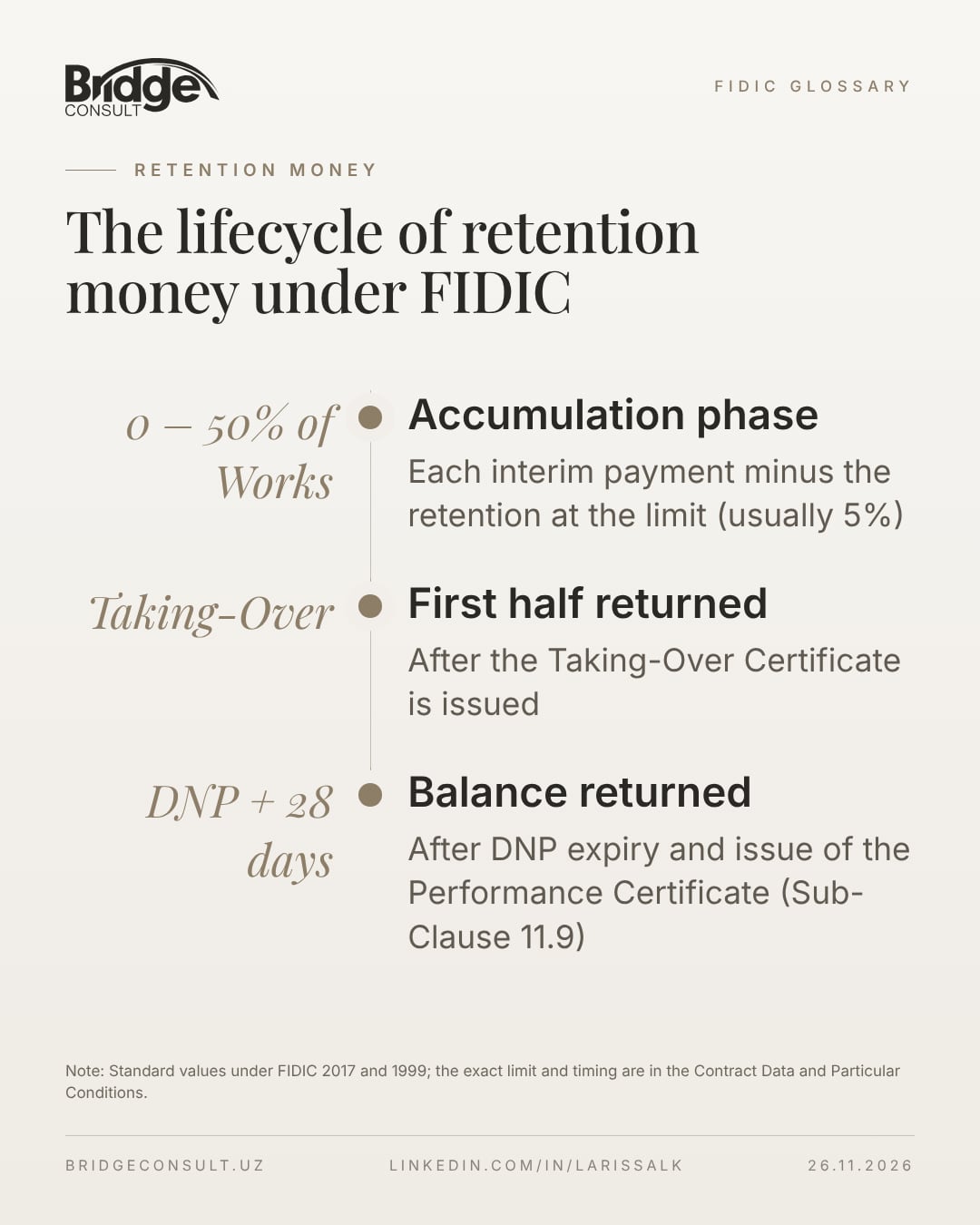
How retention money works in practice: limits and return timing
The mechanism works in three phases. Phase 1 — accumulation: the Contractor does not receive each interim payment in full but receives it minus the retention at the agreed limit. Phase 2 — first half: after the Taking-Over Certificate is issued, the Employer returns the first half of the accumulated retention to the Contractor. Phase 3 — balance: after the DNP expires and the Performance Certificate is issued, the second half is returned. The full return scheme and its link to Taking-Over are covered in the Taking-Over Certificate under FIDIC.
- Retention limit — standardly 5% up to 50% of the Works value and 0% thereafter (ceiling 10%; the exact value is in the Contract Data).
- The first half of the retained amount is returned after the Taking-Over Certificate is issued.
- The balance is returned after the DNP expires and the Performance Certificate is issued.
- Currency of retention — by default the same currency as the Contract; a different one only if stated in the Contract Data.
- A delay in the return gives the Contractor a right to financial charges under Sub-Clause 14.8 (General Conditions); the parameters may be varied by the Particular Conditions.
Typical contractor and employer mistakes in dealing with retention
- Unverified limit in the Contract Data. The Contractor calculates on the standard 5%, while the Particular Conditions set the limit at 10% or a fixed amount; the mismatch flows into the calculations and into a dispute.
- Assuming the first half is automatic. The return is tied to an event: the issue of the Taking-Over Certificate (Sub-Clause 14.9 in 2017; 14.10 in 1999). No event, no right to demand the return, even if the DNP is still running.
- The Contractor does not request the Performance Certificate after DNP. Without it, the second half of the retention is not returned; see Sub-Clause 11.9 on the Defects Notification Period.
- Retention is not reflected in the cash flow. The Contractor plans the payment of subcontracts and materials on the full payment amount, but in fact receives it minus the retention; on long projects this turns into months of free financing for the Employer.
- The interest on financial charges for late return is not claimed. If the return is delayed, the Contractor must explicitly request compensation under Sub-Clause 14.8; silence means lost money.
- The Employer holds the balance after the Performance Certificate. This is a direct breach of the mechanism; the Contractor records the breach and, where necessary, moves to a Sub-Clause 20.2 claim.
The cumulative effect of these mistakes is that retention becomes free credit: the Contractor in effect finances its Employer for the entire DNP and beyond. In MDB projects and long DNP this is a material amount of working capital frozen without interest. The prevention — an accurate retention calculation on every interim valuation and a fixed claim to interest. A practical walkthrough of payment and retention calculations is in FIDIC contract support.
How retention money differs from performance security
| Parameter | Retention Money | Performance Security |
|---|---|---|
| What it is | A percentage withheld from each payment | A bank guarantee or collateral (usually 10% of the price, exact value in the Contract Data) |
| Timing | Returned after Taking-Over and after DNP | Submitted within 28 days of the Letter of Acceptance (Sub-Clause 4.2) |
| Function | Incentive to rectify defects during DNP | Security for the performance of the Contractor's obligations |
Retention Money and Performance Security cover different risks and different phases. Performance Security (Sub-Clause 4.2) is a security at the execution phase, which the Contractor submits within 28 days of receiving the Letter of Acceptance. Retention Money is a mechanism at the defects-liability phase: it is returned only after Taking-Over and the expiry of the DNP. In most contracts both instruments coexist and add up for the Contractor as “frozen capital”. If the Employer refers to both retention and security in a single demand, it is important for the Contractor to calculate precisely what amount has been withheld and what has been posted as collateral. Related terms and their role in the dispute mechanism are covered in Notice of Claim under FIDIC.
Related terms and where to see the details
- Defects Notification Period (DNP) — the warranty period after which the balance of the retention is returned.
- Taking-Over Certificate — the event after which the first half of the retention is returned.
- Performance Certificate — issued under Sub-Clause 11.9; after its issue the Contractor treats its obligations as discharged.
- Delay Damages and EOT — adjacent calculation mechanisms in Clause 8; do not confuse them with retention, but they do intersect in payment calculations.
- Notice of Claim — if the Contractor disagrees with the Engineer’s decision on the return, the dispute proceeds under 20.2.
A practical walkthrough of retention and payment calculations on specific cases is in Academy Bridge Consult, where the “Advanced Contract Management” course has a dedicated module on the calculation of Statements and retention. On disputes over the return and its timing — see the article on DAAB in FIDIC contracts.
Frequently asked questions
What is retention money under FIDIC in simple terms?
It is a percentage withheld from each interim payment that the Employer keeps as security for the rectification of defects. The return happens in two stages — after the Taking-Over Certificate is issued and after the DNP expires. The standard limit is 5% up to 50% of the Works and 0% beyond that; the exact value is in the Contract Data.
When does the contractor get the retention back under FIDIC?
The first half of the retained amount — after the Taking-Over Certificate is issued (Sub-Clause 14.9 in 2017; 14.10 in 1999). The balance — after the Defects Notification Period expires and the Performance Certificate is issued under Sub-Clause 11.9.
What is the standard retention percentage under FIDIC?
The typical limit is 5% of the accumulated value of Works executed up to 50% of the price, and 0% beyond that threshold. The ceiling of the retention is 10% (a Contract Data value). If the Particular Conditions have changed it, the amended value applies.
How does retention money differ from performance security?
Retention Money is a withholding from each payment returned in two stages after DNP; Performance Security is a guarantee or collateral (usually 10% of the price, exact value in the Contract Data) that the Contractor submits within 28 days of the Letter of Acceptance under Sub-Clause 4.2. They cover different phases and risks and usually operate together.
Sources and references
- FIDIC Red Book 2017: Sub-Clause 14.9 (Retention Money)
- FIDIC Red Book 1999: Sub-Clause 14.10 (Return of Retention Money) and Sub-Clause 14.12 (Retention Money)
- FIDIC Red Book 2017: Sub-Clause 11.9 (Performance Certificate), 14.10 (Statement at Completion), 14.13 (Final Payment Certificate)
How Bridge Consult can help
Bridge Consult supports employers and contractors on FIDIC contracts — from reviewing conditions and notices to claims, DAAB proceedings and arbitration. Founder Larissa Belousova is a FIDIC Certified Consulting Engineer and an ADB Accredited Contract Management and Dispute Avoidance Specialist.
Have a question about a live contract? Contact us and we will look at your situation.
This term in our articles
- Thermal and Nuclear Power in Jizzakh: How Mega-Projects Are Raising the Bar on EPC Contracts and Subcontract Procurement
- International Arbitration Against Turkish Investors: What It Means for FIDIC Contracts
- IFI Tenders in Uzbekistan and Central Asia: November 2026 Overview
- Full contract administration: BRIDGE Consult has expanded its services for contractors
- BRIDGE Consult authors the Uzbekistan chapter in ICLG Construction & Engineering Laws and Regulations 2026
Other terms
FIDIC Uzbekistan
Expert materials, case studies and event announcements on FIDIC contracts in Central Asia — before they reach the site.