
FIDIC Exceptional Event: Force Majeure and the Notification Procedure under Clause 18
Exceptional Event is a broader list of circumstances than ordinary force majeure, entitling the Contractor to both an extension of time and cost recovery. We examine Clause 18 of FIDIC 2017, the notification procedure, and common pitfalls so the Contractor does not lose compensation.
 Larissa Belousova
An Exceptional Event is an event or circumstance of an exceptional or extraordinary nature or effect that neither party could reasonably have foreseen, avoided or overcome at the time of Contract signing, and whose occurrence entitles the Contractor to an Extension of Time and to cost recovery for work and expenses incurred as a result. In FIDIC 2017, this mechanism is set out in Clause 18 (the predecessor of force majeure in the 1999 edition).
Where the Contractor faces a flood, an armed conflict or a pandemic and wants to protect both the programme and the contract price, it relies on Clause 18. Classic force majeure in the 1999 edition (Clause 17) granted the Contractor both an EOT and cost recovery within a single clause; the 2017 edition relocated the mechanism to a standalone Clause 18 and specified a 14-day notice (18.2). The key practical trap is missing the notice deadline: without the Notice, a subsequent Claim may be rejected. Where the Particular Conditions have not altered the list of events or the deadlines, this procedure applies as written.
In brief: Exceptional Event under FIDIC 2017 (Clause 18) entitles the Contractor to both an extension of time and cost recovery. To preserve the right, a notice (18.2) must be issued within 14 days, followed by a claim under 20.2 with a calculation of the EOT and the cost. The specific list of events and consequences is governed by the General Conditions unless varied by the Particular Conditions.
What Exceptional Event Means and Its Core Substance
An Exceptional Event is a circumstance the Contractor could not reasonably have foreseen at the date of signing the Contract, which it could not reasonably have influenced and against which it could not reasonably have taken measures to avoid or mitigate. Clause 18 of FIDIC 2017 (formerly force majeure) covers a wide range of events: natural disasters, epidemics, armed conflicts, military operations and other events of force majeure, as well as circumstances that are neither acts of nature nor attributable to the Employer.
The consequences of an Exceptional Event under the 2017 edition: the Contractor is entitled to an extension of time (EOT) and to cost recovery for the work and expenses arising from the event, including overheads for maintaining personnel and equipment. In the 1999 edition, the equivalent mechanism sat in Clause 17 (Force Majeure and Exceptional Circumstances) and granted the Contractor both an EOT and cost recovery within a single clause; in 2017 the structure was reorganised and the mechanism moved to a standalone Clause 18. The specific consequences and list of events in each contract must be checked against the Particular Conditions.
| Parameter | Exceptional Event, Clause 18 (FIDIC 2017) | Force Majeure, Clause 17 (FIDIC 1999) |
|---|---|---|
| Right to an EOT | Yes | Yes |
| Cost recovery | Yes — costs and overheads | Yes |
| Notice deadline | 14 days from when the Contractor became aware (18.2) | 28 days (under Clause 17) |
| List of events | Force majeure, military operations, epidemics, natural disasters | Force majeure, military operations, epidemics |
On evidence for delays and events of any kind, Larissa Belousova wrote in her channel:
«A delay is not the problem. The problem is when there is no evidence.»
Where Exceptional Event Sits in the Contract: Books and Editions
In FIDIC 2017, Clause 18, Exceptional Events, is a standalone chapter, separated from Clause 19, Insurance. In FIDIC 1999, the equivalent mechanism was located in Clause 17, under Force Majeure and Exceptional Circumstances. In each specific contract, the list of events and consequences of an Exceptional Event must be checked against the Particular Conditions and the Contract Data — the parties may have widened or narrowed the list, for example by adding or excluding a sanctions regime or a specific type of epidemic.
- Clause 18 — Exceptional Events: definition and consequences for time and cost
- 18.2 — the Contractor’s notice within 14 days of becoming aware of the event
- 8.5 — extension of time (EOT) where the event affects the Completion Date
- 20.2 — the procedure for submitting a cost claim (a fully detailed claim within 84 days)
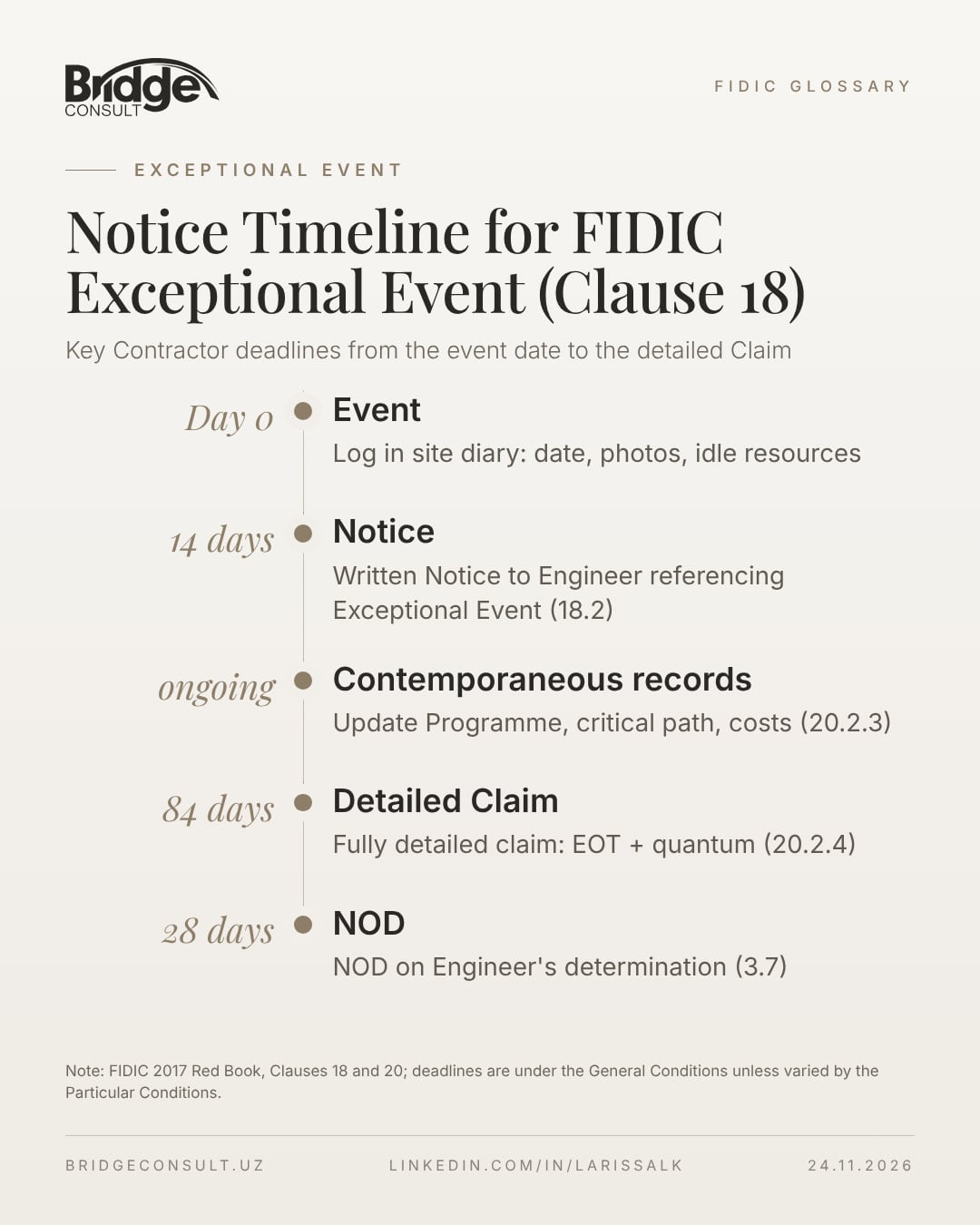
How It Works in Practice: A Step-by-Step Procedure
- Day 0 — the event occurs (flood, sanctions imposed, epidemic). Record the date, time and substance of the event, photographs and video, idle resources, and a same-day entry in the site diary.
- Within 14 days — issue a written Notice to the Engineer stating what occurred, with reference to Exceptional Event (Clause 18), and retain proof of dispatch. Without this Notice, the subsequent claim may be rejected as time-barred.
- Throughout the event — keep the Programme updated, record the critical path, correspondence, meeting minutes and all costs (Contemporaneous Records under 20.2.3).
- Within 84 days — submit a fully detailed claim under 20.2.4 with a calculation of the EOT and the cost (quantum).
- In parallel — where the Employer or Engineer does not agree, issue an NOD against the Engineer’s determination within 28 days (3.7), otherwise it becomes final. Where needed, proceed to the DAAB and then to arbitration (Clause 21).
Common Contractor Mistakes
- Missing the 14-day notice deadline (18.2): without the Notice, the subsequent Claim may be dismissed as time-barred.
- No evidence of a causal link: it is not demonstrated which works were affected, which resources were idle, or how the event fell on the critical path.
- Carrying over the domestic concept of force majeure from the Uzbek Civil Code into FIDIC without adaptation: the law of Uzbekistan may limit the effect of the contract terms, for example limitation periods and the acceptance procedure; under FIDIC, Clause 18 and the Particular Conditions govern.
- Unaccounted impact on cost: the Contractor claims only an EOT, although for an Exceptional Event it is entitled to overheads for maintaining personnel and equipment during the event.
- Confusing the 1999 and 2017 editions: the Contractor applies the deadlines and numbering of the 1999 form to a 2017 contract (or vice versa), so the notice is sent to the wrong clause and a deadline that is not in fact applicable.
What Exceptional Event Is Often Confused With and Related Terms
Exceptional Event (Clause 18) is most often confused with Clause 17, Risks and Responsibility for Care of the Works — the latter governs the care of the Works until they are handed over, not external circumstances affecting time and cost. Confusion of editions is also common: in the 1999 form the equivalent mechanism sat in Clause 17, while in the 2017 form it was moved to Clause 18.
A practical benchmark: where the event falls within the list of Exceptional Events and the Contractor could not reasonably have foreseen it, it is entitled to both an EOT and cost recovery under Clause 18, provided the Particular Conditions have not altered the list. In contested cases, whether an event qualifies as an Exceptional Event is first determined by the Engineer under 3.7 (consultation between the parties, then a determination); where there is disagreement, an NOD within 28 days, followed by amicable settlement, the DAAB and arbitration (Clause 21). For more on extensions of time under different grounds, see EOT: How a Contractor Can Legitimately Extend Deadlines and Avoid Liquidated Damages, and on the deadlines and mechanism of the Notice of Claim — in the glossary article.
Frequently asked questions
What is an Exceptional Event under FIDIC and how does it differ from ordinary force majeure?
Exceptional Event (Clause 18 of FIDIC 2017) is an expanded list of circumstances covering force majeure, military operations, epidemics and other events of force majeure. The Contractor is entitled to both an extension of time and cost recovery for the work and expenses incurred, provided the Particular Conditions have not altered the list. In FIDIC 1999 the equivalent mechanism was called Force Majeure and Exceptional Circumstances and sat in Clause 17.
What is the notice deadline for an Exceptional Event under FIDIC 2017?
The Contractor must issue a written notice within 14 days of becoming aware, or ought to have become aware, of the event (18.2). Where the Particular Conditions have not varied the deadline, it is 14 days. Without a timely Notice, the subsequent claim may be dismissed as time-barred.
Does an Exceptional Event affect the programme and liquidated damages under FIDIC?
Yes. Where an event under Clause 18 falls on the critical path, the Contractor is entitled to an EOT under 8.5 and does not pay Delay Damages for those days. Costs and overheads for maintaining personnel and equipment arising from the event are also recoverable.
Can a Contractor recover the cost of an Exceptional Event into the price under FIDIC?
Yes. The Contractor is entitled to cost recovery for the work and expenses arising from the event, where it falls within the list of Exceptional Events under Clause 18 and the Particular Conditions have not restricted this right. A fully detailed claim is submitted within 84 days under 20.2.4.
Sources and references
- FIDIC 2017 Red Book, Clause 18 Exceptional Events
- FIDIC 2017 Red Book, Clause 18.2
- FIDIC 2017 Red Book, Clause 20.2
- FIDIC 2017 Red Book, Clause 8.5
- FIDIC 1999 Red Book, Clause 17 Force Majeure
How Bridge Consult can help
Bridge Consult supports employers and contractors on FIDIC contracts — from reviewing conditions and notices to claims, DAAB proceedings and arbitration. Founder Larissa Belousova is a FIDIC Certified Consulting Engineer and an ADB Accredited Contract Management and Dispute Avoidance Specialist.
Have a question about a live contract? Contact us and we will look at your situation.
This term in our articles
Other terms
FIDIC Uzbekistan
Expert materials, case studies and event announcements on FIDIC contracts in Central Asia — before they reach the site.