
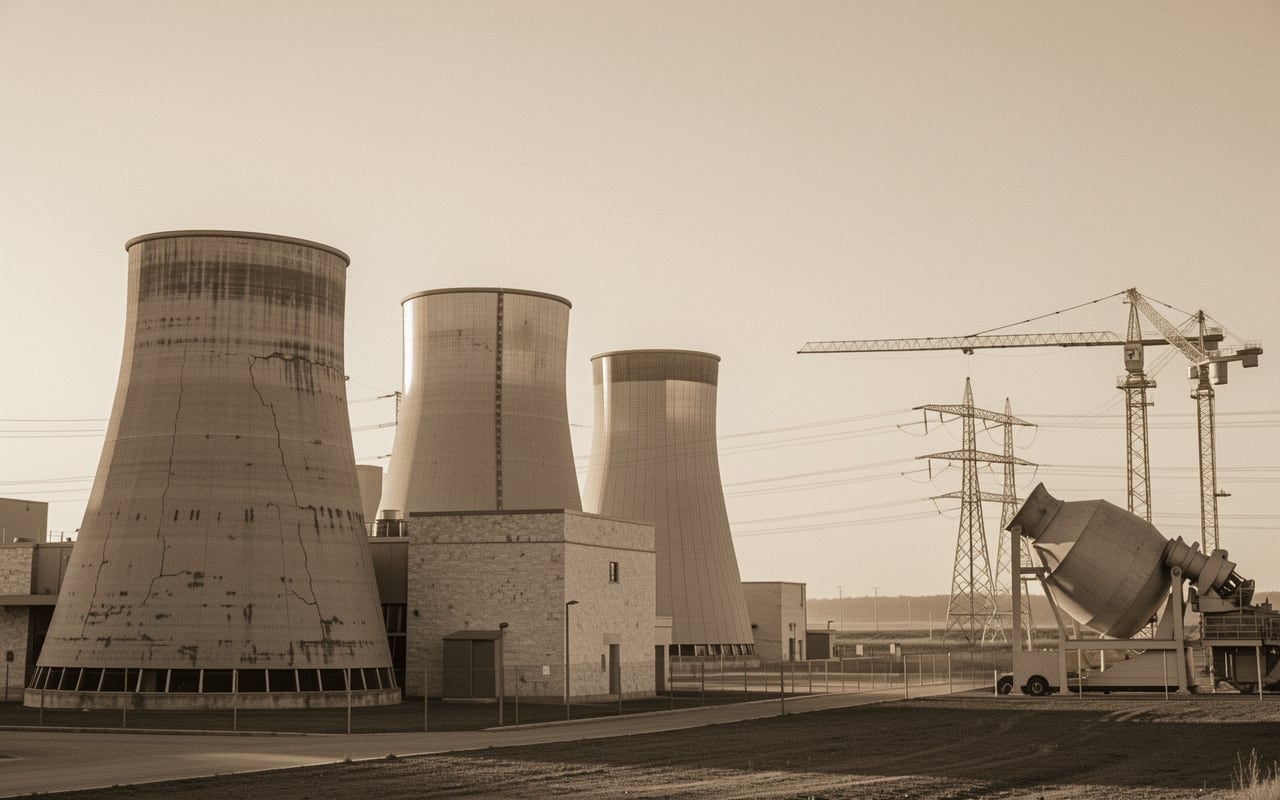
Thermal and Nuclear Power in Jizzakh: How Mega-Projects Are Raising the Bar on EPC Contracts and Subcontract Procurement
With the 550 MW Jizzakh thermal plant commissioned and a $2.2 billion procurement for the nuclear plant announced, Uzbekistan's energy contracting market is rebuilding its contract architecture: risk allocation, variations, subcontract management and DAAB selection are now the key control points on every mega-project.
 Larissa Belousova
On 20 November 2026, the 550 MW Cengiz Enerji Jizzakh thermal plant was connected to the Unified Energy System, and on 20 November the President announced a need for $2.2 billion of materials to build a nuclear plant in Jizzakh Region. These events set a new scale for Uzbekistan’s energy programme — and new requirements for contracting.
We break down what changes for employers, contractors and engineers: how TIPP project contract architecture is built, where variation and subcontract risks arise, and why DAAB stops being an abstraction on projects of this kind.
In brief: The successful commissioning of the Jizzakh thermal plant and the large-scale procurement for the nuclear plant show that large energy projects in Uzbekistan demand a clear FIDIC/EPC contract architecture, deliberate risk allocation, regulated subcontracting and the constant operation of DAAB. Contractors and employers who do not build these mechanisms up front lose money on EOT, liquidated damages and missed notices.
Commissioning the Cengiz Enerji Jizzakh thermal plant: context and what it means for the market
The thermal plant in Sharafo-Rashidov District of Jizzakh Region was built by the Turkish company Cengiz Enerji through the project structure Cenergo. The station runs on combined-cycle gas turbine units, generates 4.4 billion kWh a year and saves 500 million cubic metres of gas annually. The investor took on the full TIPP cycle: design, finance, construction and operation. The total project cost is $500 million, financed through a long-term loan from DZ Bank and DenizBank of €164 million.
This is not Cengiz’s first plant in Uzbekistan: in 2022 the company commissioned two thermal plants — 240 MW in Kibray and 220 MW in Khavast. The successful TIPP commissioning confirms that the market can absorb projects with the full risk package on the investor. For contractors this is a signal: employers (including state entities) will increasingly insist on EPC/F structures with strict risk allocation and a guaranteed volume of electricity delivery.
On how non-obvious disputes over the Engineer’s role become a primary cause of disagreement on infrastructure projects, Larissa Belousova wrote in her channel:
«In practice, a significant part of the disputes on infrastructure projects arise around precisely these questions.»
The standard TIPP contract architecture: Red Book or Silver Book
The TIPP model, in which the investor takes on design, finance, construction and operation, is by nature closer to EPC or EPC+F. For such projects the FIDIC Silver Book — EPC/Turnkey — is usually used, where most of the risk falls on the Contractor and the Engineer role is replaced by the Employer’s Representative. But for TIPP assets with a separate O&M contract and a generation guarantee, the Red Book and Yellow Book may also be applied, depending on who designs and how much control the investor needs.
| Criterion | FIDIC Red Book | FIDIC Silver Book |
|---|---|---|
| Design | Employer | Contractor |
| Risk on the Contractor | Partly | Most of it |
| Engineer role | Neutral consultant | Employer's Representative |
| Typical uses | Infrastructure, bridges, roads | TIPP energy, plants, EPC/F |
| Particular Conditions complexity | Moderate | High (many bespoke risks) |
For energy projects in Uzbekistan, where the employer is the state and the procurement volume is on the scale of $2.2 billion, the Particular Conditions occupy no less than the General Conditions. The key task for the contractor at tender stage is not to sign a Silver Book “as is”, but to understand which risks are pushed into the Particular Conditions and what the actual liability is. More on choosing the pro forma in our article on the FIDIC Red Book vs Yellow Book, and on checking the price in EPC+F in the EPC+F price checklist for Uzbekistan.
The nuclear plant in Jizzakh: $2.2 billion procurement and requirements for subcontract supply chains
The President announced that $2.2 billion of product will be needed to build the nuclear plant in Jizzakh Region. For its production, a 200-hectare industrial zone will be created in Egizbulak, where 70 types of building materials will be manufactured. From 2027, $200 million at 6% annual interest with a two-year grace period will be allocated to the production of new high-value-added building materials, and enterprises will be reimbursed 10% of the cost of energy-saving equipment (up to 1 billion soms).
For the nuclear plant’s main contractor this means the contract will carry strict local content requirements — the President has directed that the share of local product be raised to 30%. This is a direct schedule risk: if subcontract supply chains are not confirmed at the level of specific deliveries and dates, the main contractor carries the delivery-delay risk itself, even if the supplier is not ready. In FIDIC this is a classic situation where 8.4 (Advance Warning in the 2017 Edition) obliges the contractor to flag risks in advance, and 20.2.1 — to notify a claim within 28 days of when the contractor became aware of the event.
- 30% local content — a requirement on the share of local product; do not lock it into the contract without checking the production capacity of the Egizbulak industrial zone.
- 70 types of product — subcontract supply chains must be confirmed before the main contract is signed; otherwise delivery delays become the main contractor’s risk.
- 200 ha industrial zone — check who owns the site and what restrictions on shipping out the product are built into the terms.
- $200 million at 6% — financing for building-materials production; clarify whether this is included in the delivery schedule or is a separate funding stream.
- Amicable settlement under 21.5 — if a dispute with a subcontractor is not resolved through the DAAB, default arbitration (ICC) can take 12–18 months; in energy contracts this is critical.
The employer’s position: how to minimise risk in EPC/F and variation control
For the employer (the state, an MFI, an investor), the key risks in energy EPC/F contracts sit in three zones: payment (including advance payments, escalation and retention release), time (delay in substantial completion and Loss of Revenue) and quality (post-handover defects, DNP). Under FIDIC 2017 (Red Book) the payment sequence is: interim payment — within 28 days of receipt of the Statement, final — within 56 days. Retention Money is returned in two stages: the first half after handover, the balance after the DNP expires (default 1 year unless specified in the Contract Data).
Variations (Changes) are a separate risk zone. In the Silver Book 2017 the variation mechanism works on the Employer’s instruction (13.3.1) or through a request for a proposal (13.3.2). For projects of $500 million and above, the employer needs every variation fixed before works start: price, dates, documentation. A contractor that treats the Engineer’s instruction as a change must immediately notify that fact before starting the works (3.5), otherwise it loses the right to payment. For the employer this is a control tool: if the contractor did not notify, the work falls within the contract price.
| Risk | Carried by | FIDIC mechanism | What to check in the contract |
|---|---|---|---|
| Employer's documentation delay | Employer | 1.9 / 2.1 | Who must provide it and when; date fixation |
| Equipment delivery delay | Contractor (unless an Exceptional Event) | 18 / 8.4 Advance Warning | Boundary of Exceptional Events; 8.4 notices |
| Variation without agreed price | Disputed | 13.3.1 / 13.3.2 / 3.7 | Variation price agreement procedure; NOD |
| Additional works beyond scope | Employer | 13 / 14 | Boundary of Additional Work; 13 limits |
| IPC payment overdue | Employer (financial charges) | 14.6 / 14.8 | Financial-charges rate; payment schedule |
Contractor practice: critical EOT, Delay Damages and Notice of Claim points in energy
For a contractor on an energy EPC asset, 28 days is not a formality but a time bar: missing 20.2.1 (Notice of Claim) means losing the right to compensation. Under FIDIC 2017 the contractor must serve a Notice of Claim no later than 28 days from when it became aware, or ought to have become aware, of the event. If the contractor did not notify, the employer has no obligation to make good the loss. On projects of $500 million, where a 10-week EOT can cost hundreds of thousands of dollars a day, this is no abstraction.
- Fix the event: a date stamp in the site diary, a protocol, correspondence — everything that proves the moment the contractor became aware of the event.
- Notice of Claim (20.2.1): within 28 days, in writing, expressly designated as a Notice. Without it — time bar.
- Fully substantiated claim (20.2.4): within 84 days, with the EOT calculation and cost.
- Agreement or Determination of the Engineer (20.2.5 / 3.7): if there is no agreement — a NOD within 28 days, otherwise the Determination becomes final.
- DAAB (21): referral of the dispute; decision — 84 days; NOD — 28 days; amicable settlement — 28 days.
- Arbitration (21.6): default ICC; failure to enforce the DAAB decision — 21.7.
Delay Damages in energy contracts are not only about the delay itself but about Loss of Revenue: if the thermal plant is not completed on time, the employer loses revenue from the sale of electricity. The Delay Damages cap under 8.8 is set in the Contract Data; if it is not specified, the contractor risks unlimited liability. In the Particular Conditions of large energy projects this cap is often fixed as a percentage of the contract price. Check this clause before signing. On how to lawfully extend the time for completion and avoid liquidated damages, see our article on EOT under FIDIC.
The role of DAAB and arbitration: why it is a key cost line on the project
The DAAB in FIDIC 2017 is not a formality but a standing board that operates throughout the project. It helps prevent disputes (21.3 — informal assistance at the joint request of the parties) and resolve them (21.4 — a decision within 84 days of referral). On energy projects with contracts of $500 million and above, the cost of the DAAB procedure is a significant cost line. If the DAAB does not function (no appointment, no funding), the contractor and the employer fall into arbitration — ICC, 12–18 months, with a cost comparable to a month of the plant’s revenue.
- DAAB appointment (21.1) — check who appoints it and when; on large projects the DAAB is appointed before works start, not after the dispute arises.
- DAAB funding — the Particular Conditions must state who pays (usually 50/50, but on TIPP projects it may differ).
- DAAB decision (21.4) — 84 days; NOD — 28 days; if no NOD is served, the decision becomes binding.
- Amicable settlement (21.5) — 28 days; missing it means moving to arbitration.
- Arbitration (21.6) — default ICC; in contracts involving Russia/CIS parties it is often TIAC or ICAC at the UCCCI. Ensure the arbitral institution and governing law are stated in the Contract Data.
In Uzbekistan, arbitration of energy contracts increasingly goes to TIAC or ICAC at the UCCCI. Arbitrator Larissa Belousova’s profile is published in the GAR Arbitrator Research Tool — meaning FIDIC contract expertise in Uzbekistan is represented in international arbitral centres. On the difference between DAAB and DAB (important not to confuse in the contract), see FIDIC DAB vs DAAB, and on what a DAAB is and why it is needed, see DAAB in FIDIC explained.
Practical checklist: 5 questions before signing a thermal or nuclear plant contract
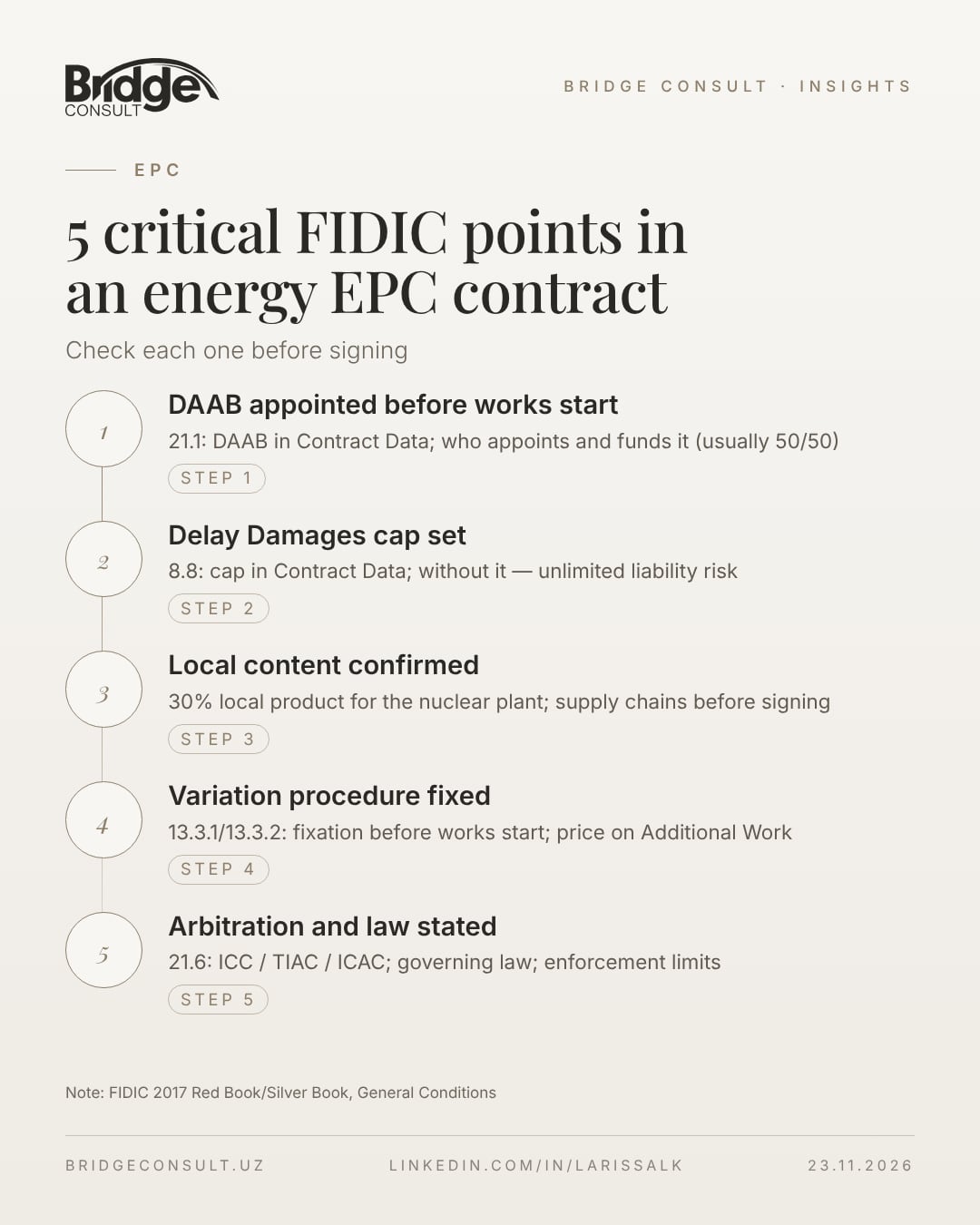
- Who appoints the DAAB and when? (21.1) — before works start or after the dispute? Is the DAAB stated in the Contract Data?
- What is the Delay Damages cap? (8.8) — if not specified, verification is mandatory; in energy contracts this is often Loss of Revenue.
- What local content model is fixed? (30% for the nuclear plant) — are the subcontract supply chains confirmed before signing?
- What is the variation agreement procedure? (13.3.1 / 13.3.2) — before or after works start; is there a fixed-price mechanism for Additional Work?
- Which arbitral institution and law are stated? (21.6) — ICC, TIAC or ICAC; are there limits under national law on enforcing the award?
Frequently asked questions
Which FIDIC contracts are used for TIPP projects in Uzbekistan?
For TIPP assets (the investor takes on design, finance, construction and operation) the FIDIC Silver Book — EPC/Turnkey — is most often used. For projects with a separate O&M contract and a generation guarantee, the Red Book or Yellow Book with extended Particular Conditions may apply.
What is the Notice of Claim deadline under FIDIC 2017 and what happens if it is missed?
Under 20.2.1 (2017 Edition) the contractor must serve a Notice of Claim within 28 days of when it became aware of the event. Missing the deadline leads to a time bar — loss of the right to compensation, even if the event genuinely occurred.
What is the 30% local content in the context of the Jizzakh nuclear plant?
The President of Uzbekistan has directed that the share of local product in the nuclear project be raised to 30%. This means the $2.2 billion building-materials procurement will be partly produced in the Egizbulak industrial zone (200 ha, 70 types of product). For the main contractor this is a delivery-time risk that must be fixed in the contract before signing.
Why is the DAAB critical for energy contracts?
The DAAB is a standing board that helps prevent disputes throughout the project. The cost of a DAAB procedure is far lower than 12–18 months of ICC arbitration. If the DAAB does not function, the parties fall into arbitration with an unpredictable timeline.
Which arbitral institution applies to FIDIC contracts in Uzbekistan?
FIDIC 2017 defaults to ICC, but the Particular Conditions of contracts with Uzbek employers often state TIAC (Tashkent International Arbitration Centre) or ICAC at the UCCCI. The specific institution and governing law are set out in the Contract Data.
Sources and references
- Spot – Business news of Uzbekistan: Cengiz Enerji’s Jizzakh thermal plant begins supplying power to the grid
- Spot – Business news of Uzbekistan: $2.2 billion of materials to be used for the Jizzakh nuclear plant — President
- FIDIC Silver Book 2017, clause 21.4 (DAAB)
- FIDIC Silver Book 2017, clause 20.2.1 (Notice of Claim)
How Bridge Consult can help
Bridge Consult supports employers and contractors on FIDIC contracts — from reviewing conditions and notices to claims, DAAB proceedings and arbitration. Founder Larissa Belousova is a FIDIC Certified Consulting Engineer and an ADB Accredited Contract Management and Dispute Avoidance Specialist.
Have a question about a live contract? Contact us and we will look at your situation.
Read next


FIDIC Uzbekistan
Expert materials, case studies and event announcements on FIDIC contracts in Central Asia — before they reach the site.