

Float in FIDIC Contracts: Who Owns It and How That Affects Your EOT
Time float in a construction programme is not just a scheduling line item; it is a tool for allocating risk. We break down three ownership-of-float models, how each of them affects EOT and delay claims, and what you need to put into the Particular Conditions to avoid disputes over time.
 Larissa Belousova
One of the most undervalued issues in construction contract management is the ownership of float. Time float in the programme bears directly on entitlement to an Extension of Time, the assessment of delay claims, and the allocation of risk between the Employer and the Contractor.
In international practice there are three main approaches to float ownership: it belongs to the Contractor, it belongs to the Employer, or it is a shared project resource. The problem is that many contracts do not regulate this point at all, which later becomes the root cause of serious disputes when delays are assessed and claims are determined. If the contract does not set out the rules for using float, the parties may interpret their respective rights to EOT and compensation differently. Float ownership is not a planning question, but a contract risk-management question.
In brief: Float ownership is not a planning issue, but a contract risk-management issue. The three models (contractor, employer, shared) determine entitlement to EOT and the allocation of time risk differently. If the Particular Conditions are silent, the parties will dispute who bears the risk of delay.
What is float and how it is calculated in the programme
Float is the cushion of time between when an activity can be completed in accordance with the programme and its latest permissible start or finish without affecting the completion date. There are two types: total float — the maximum shift of an activity in time without affecting the project completion date — and free float — the shift of an activity without affecting the start of the following activity.
The calculation method is a CPM-Backward Pass applied to the logic agreed with the Employer. The Contractor submits the programme under sub-clause 8.3 of the FIDIC Red Book 2017 within 28 days of the Notice of Commencement, and the Engineer reviews it within 21 days. It is in this agreed programme that the amount of float is fixed, and it is to this float that the parties later refer when assessing delays.
Larissa Belousova wrote about the under-appreciation of float ownership in her channel:
«Float ownership is not a planning issue. It is a contract risk-management issue.»
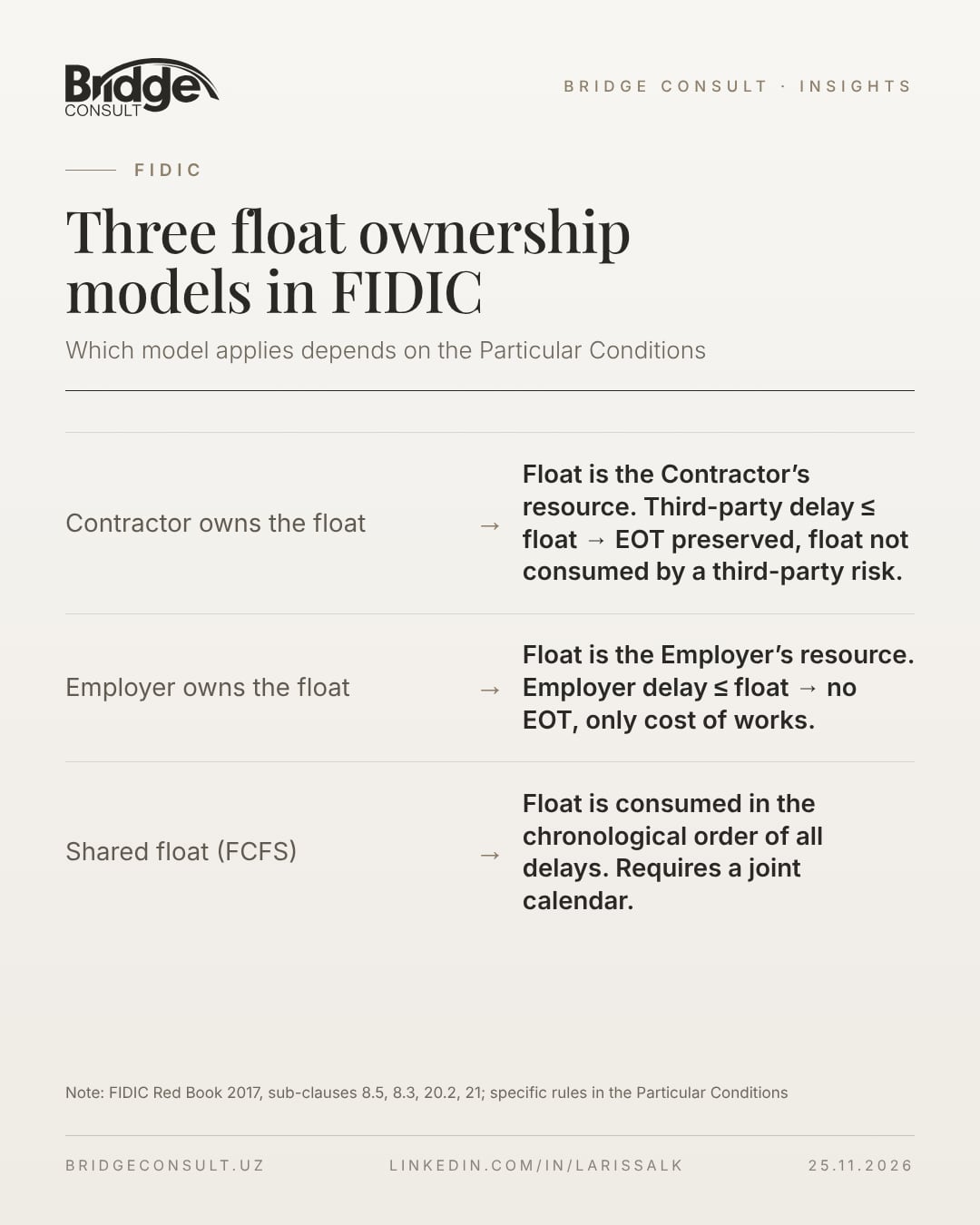
Approach 1: Float belongs to the Contractor (Contractor’s Float)
The Contractor’s position is that float is built into its programme for its own resource and management purposes — crew rotation, delivery windows, weather delays — and that it is entitled to control it. Under this logic float is a tool of the Contractor, and a delay attributable to the Employer within the float does not mean the Contractor has “used up” someone else’s risk: the Contractor is entitled to an EOT because float is not consumed by a delay attributable to the other party.
- A delay attributable to the Contractor within the float does not give rise to an EOT, because the Time for Completion in the Contract Data has not been breached.
- Where an Exceptional Event causes the delay, the Contractor’s float, even if it is formally “left” on the programme, is not counted against the Contractor: it receives an EOT for the full period of delay.
- Where the delay is attributable to the Employer, the Contractor receives an EOT and the cost of the works, because float is not consumed by the other party’s risk.
Approach 2: Float belongs to the Employer (Client’s Float)
The Employer’s position is that float is a resource available to the Employer to adjust the completion date without granting the Contractor an EOT: “You have 10 days of float, the documentation was delayed by 5 — that is 5 days of your float, no EOT.” This logic is set out in the Particular Conditions of public and infrastructure projects, where the Employer is a public authority with rigid calendar commitments.
- Where the Employer’s delay is within the float, the Contractor does not receive an EOT but is entitled to the cost of the works prolonged at the Employer’s risk.
- Where the Employer’s delay exceeds the float, an EOT is granted only for the days beyond the float.
- Where the Contractor’s delay has consumed the float, the Employer may levy Delay Damages from the day the Time for Completion is breached (on the programme treating float as a resource of the Employer).
Approach 3: Float is shared — “first come, first served” principle
In this model, float is a shared project resource: it is consumed in chronological order, whichever party “takes” it first. If the Contractor is delayed by 20 days and the Employer then delays the documentation by 10 days, the 30 days of float are consumed: the first 20 days are the Contractor’s risk, the last 10 are the Employer’s risk. This model is the most complex to apply because it requires disciplined calendar management and jointly kept records.
The standard FIDIC conditions do not contain a ready-made formula for float ownership, so where the Particular Conditions are silent, the question of how float is allocated is often resolved ex post, based on delay analysis using Time Impact or Window Analysis. Specific approaches vary across case law and arbitration practice, and the final determination depends on how the parties set out (or failed to set out) the rules in the contract.
How float affects EOT and delay claims: what changes in the parties’ rights
| Delay scenario | Contractor owns the float | Employer owns the float | Shared float (FCFS) |
|---|---|---|---|
| Contractor delay ≤ float | No EOT, no Delay Damages — time not breached | No EOT, Delay Damages from the end of the float | Float consumed by the Contractor, no EOT |
| Contractor delay > float | No EOT, Delay Damages under the Conditions of Contract unless modified by the Particular Conditions | No EOT, Delay Damages under the Conditions of Contract unless modified by the Particular Conditions | Float exhausted, Delay Damages under the Conditions of Contract unless modified by the Particular Conditions |
| Employer delay ≤ float | EOT and cost of works (float not consumed by a third-party risk) | No EOT, only cost of works | Float consumed in chronological order, cost of works is due |
| Employer delay > float | EOT for the days of delay and cost of works | EOT for the portion beyond the float, and cost of works | Float consumed by the Contractor, EOT for the remaining portion, cost of works |
Practical takeaway: the float ownership model determines which days count as the Contractor’s “risk days” and which count as the Employer’s risk days. If the model is not set out in the Particular Conditions, every dispute turns into a forensic delay analysis involving independent experts and potential escalation to the DAAB or arbitration. On the order of submitting time claims and the 28-day notices, see our article Notice of Claim in FIDIC: the 28-day deadline and time bar under sub-clause 20.2.
Practical steps: how to set out float rules in a FIDIC contract
- At tender stage, expressly set out the float ownership model in Particular Conditions Part B. Example wording: “Float calculated in the agreed programme belongs to the Contractor / the Employer / is a shared project resource on a first come, first served basis.”
- Agree the float calculation method in the programme (CPM-Backward Pass, calendar, activity durations), including rules for revising float when works are varied.
- Determine who maintains the float calendar and how its consumption is recorded: joint minutes, site diary, weekly critical-path reports.
- Agree who keeps and verifies the contemporaneous records on float — linked to sub-clause 20.2.3 of the FIDIC Red Book 2017 — because without this, no float model is workable.
- Agree the consequences: which types of delay give rise to EOT and cost, and which give rise to EOT only; link to sub-clauses 8.5 and 20.2. Contract support for these issues can be outsourced — see FIDIC contract support for contractors and employers.
What risks arise when the contract is silent
If the Particular Conditions do not define a float ownership model, disputes over delay are resolved ex post, once the parties have already diverged on the facts and the evidence. At that stage the issue moves to the DAAB or to arbitration, where a forensic delay analysis is required. To avoid reaching that point, it is better to fix the ownership rules, the calculation method, and the record-keeping procedure before the contract is signed. For more on dispute resolution, see What is the DAAB in FIDIC contracts and why your project needs it.
Allocating time risk is part of a contract manager’s systematic work, not a one-off scheduling decision. It is worth taking the Bridge Consult FIDIC Academy, where EOT, concurrent delay, and float ownership are broken down on real cases rather than abstract wording.
How this ties in with EOT generally
A properly defined float ownership model directly affects whether the Contractor has any entitlement to a time extension at all. If float belongs to the Contractor, the other party’s delay does not “eat into” its resource and the EOT is preserved; if float is the Employer’s resource, the EOT is due only for the days beyond the float. On the procedure and deadlines for lawfully extending the Time for Completion without penalty, see EOT: how a contractor can lawfully extend the deadline and avoid penalties.
Future articles in this series
In upcoming posts on this topic, Bridge Consult will walk through the first case studies: how the Employer’s delay in issuing the As-Constructed documents affects entitlement to EOT, how to assess the impact of an event on the Time for Completion without formally “searching the contract for the right clause,” and which delay analysis methods are used in international practice. These case breakdowns are published in the Bridge Consult Academy.
Practical checklist
Before signing or agreeing a FIDIC contract, make sure each of the items below is addressed in the Particular Conditions. This minimises the risk of a dispute over who owns the float and how it absorbs the parties’ delays.
Frequently asked questions
Who owns float by default in a FIDIC contract if the Particular Conditions say nothing about it?
The standard FIDIC conditions, including the Red Book 2017, do not contain a ready-made formula for float ownership. If the Particular Conditions are silent, the question is often resolved ex post on the basis of forensic delay analysis; specific approaches vary across case law and arbitration practice.
How does float affect the Contractor’s entitlement to EOT?
If float belongs to the Contractor and a delay not attributable to it falls within the float, the Contractor retains its EOT entitlement because float is not consumed by the other party’s risk. If float belongs to the Employer, the EOT is due only for the days beyond the float. If float is shared, absorption is recorded in the chronological order of the delays.
Can the contract include a clause under which the Employer is compensated for using the Contractor’s float?
In the Particular Conditions the parties may agree a compensation mechanism for the use of float, but the formula must be underpinned by a calculation method and must not contradict the Conditions of Contract. The exact wording is a matter of negotiation for each contract.
What should a Contractor do if the Employer relies on float to refuse an EOT?
Check how float was calculated in the agreed programme and which ownership model is fixed in the Particular Conditions. If the model is not defined, submit a Notice of Claim under sub-clause 20.2 within 28 days, referring to the lack of agreement, and prepare your own float absorption analysis. Record your position in correspondence so that in the DAAB or arbitration you can challenge the Employer’s unilateral interpretation.
What is the difference between total float and free float, and how does it affect disputes?
Total float is the maximum shift of an activity without affecting the project completion date; free float is the shift without affecting the start of the following activity. In time disputes, total float is usually the subject of discussion, because it is the one tied to the completion date; free float is less robust to changes in construction logic.
Sources and references
- FIDIC Red Book 2017, sub-clauses 8.3, 8.5, 20.2, 21
- FIDIC Red Book 2017, sub-clause 3.7 — Agreement or Determination
- Larissa Belousova’s post in @fidicuzb, 03.06.2026: “Who owns float in a construction project?”
How Bridge Consult can help
Bridge Consult supports employers and contractors on FIDIC contracts — from reviewing conditions and notices to claims, DAAB proceedings and arbitration. Founder Larissa Belousova is a FIDIC Certified Consulting Engineer and an ADB Accredited Contract Management and Dispute Avoidance Specialist.
Have a question about a live contract? Contact us and we will look at your situation.
Read next


FIDIC Uzbekistan
Expert materials, case studies and event announcements on FIDIC contracts in Central Asia — before they reach the site.