
FIDIC Dispute Board (DAAB) in Uzbekistan: How to Form It and Put It to Work
A step-by-step guide for contractors and employers in Uzbekistan: how to select and appoint DAAB/DAB members, the decision timelines, who bears the costs, and the most common mistakes when working with a dispute board on local construction contracts.
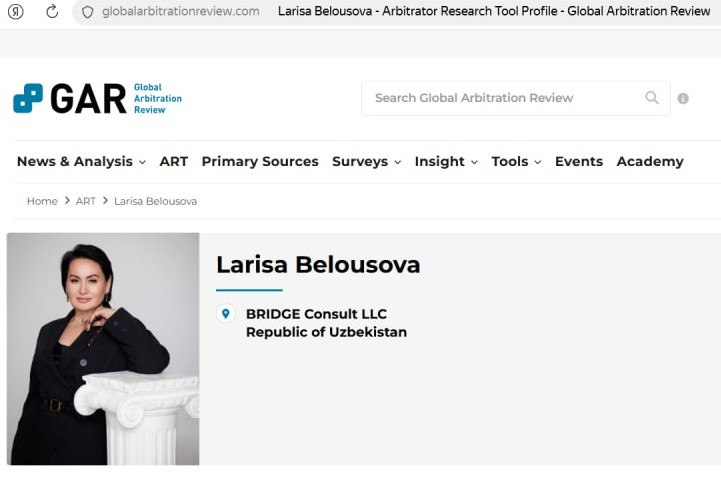
 Larissa Belousova
A Dispute Board under FIDIC contracts is a panel of independent experts who work on site alongside the construction, address disputed issues at an early stage and help the parties avoid lengthy, costly arbitration. Under FIDIC 2017 it is called the DAAB and is appointed before works commence; under FIDIC 1999 it is the DAB and is usually activated after a dispute arises. For contractors and employers in Uzbekistan working under international contracts or localised proformas, it is essential to know exactly how this body is formed, who decides and when, and who pays for its work.
In brief: A Dispute Board is an independent body that helps prevent and resolve disputes under a construction contract right on site. Under FIDIC 2017 (DAAB) it is formed in advance; under FIDIC 1999 (DAB) it is more often set up after a dispute arises. The key is to appoint members on time and to comply with notice and session-preparation deadlines, so that the decision is well reasoned and enforceable.
FIDIC Dispute Boards: DAB or DAAB — the difference and how to choose
Under FIDIC 2017 the body is called the DAAB (Dispute Adjudication/Avoidance Board). It operates in two modes: helping to avoid disputes through informal consultations at the joint request of the parties (Clause 21.3), and resolving them by issuing a formal Decision (21.4). Under FIDIC 1999 the body is the DAB (Dispute Adjudication Board), whose only function is dispute resolution (Clauses 20.2–20.4); there is no avoidance mechanism. In the 1999 Red Book the DAB is permanent, while in the Yellow and Silver Books it is a single dispute board (ad hoc), formed only after a dispute arises. In the 2017 editions the DAAB is permanent in all three Books. Read more about the difference between the two acronyms in our article DAB vs DAAB.
| Criterion | DAB — FIDIC 1999 | DAAB — FIDIC 2017 |
|---|---|---|
| Function | Dispute resolution only (20.2–20.4) | Avoidance + resolution (21.3–21.4) |
| Composition | Permanent in Red; single dispute (ad hoc) in Yellow/Silver | Permanent in all three Books |
| Decision | Within 84 days of referral | Within 84 days of referral |
| Amicable period | 56 days (20.5) | 28 days (21.5) |
Larissa Belousova wrote in her channel that Dispute Boards are a working tool, not a formality:
«As part of the Caucasus and Central Asia Construction Forum 2026 in Yerevan, a panel discussion will take place: 'Dispute Boards or arbitration — which mechanism is better suited to construction disputes?'»
Mandatory conditions for forming a Board under FIDIC contracts
The Board does not simply ‘switch on’ automatically. For it to become operational, several parameters must be agreed in the contract. Under the 2017 edition the key clause is 21 (appointment — 21.1); under 1999 it is Clauses 20.2–20.4. Without fixed rules, the appointment process itself becomes a dispute about how to appoint the Board.
These points determine how the Board will operate on your project.
- Number of members: 1 or 3 (a single-member Board is typical for projects up to a certain size; a three-member Board for larger ones).
- Selection and appointment criteria and procedure for each member, and who makes the final decision.
- Currency, the remuneration mechanism for members and the allocation of costs between the parties.
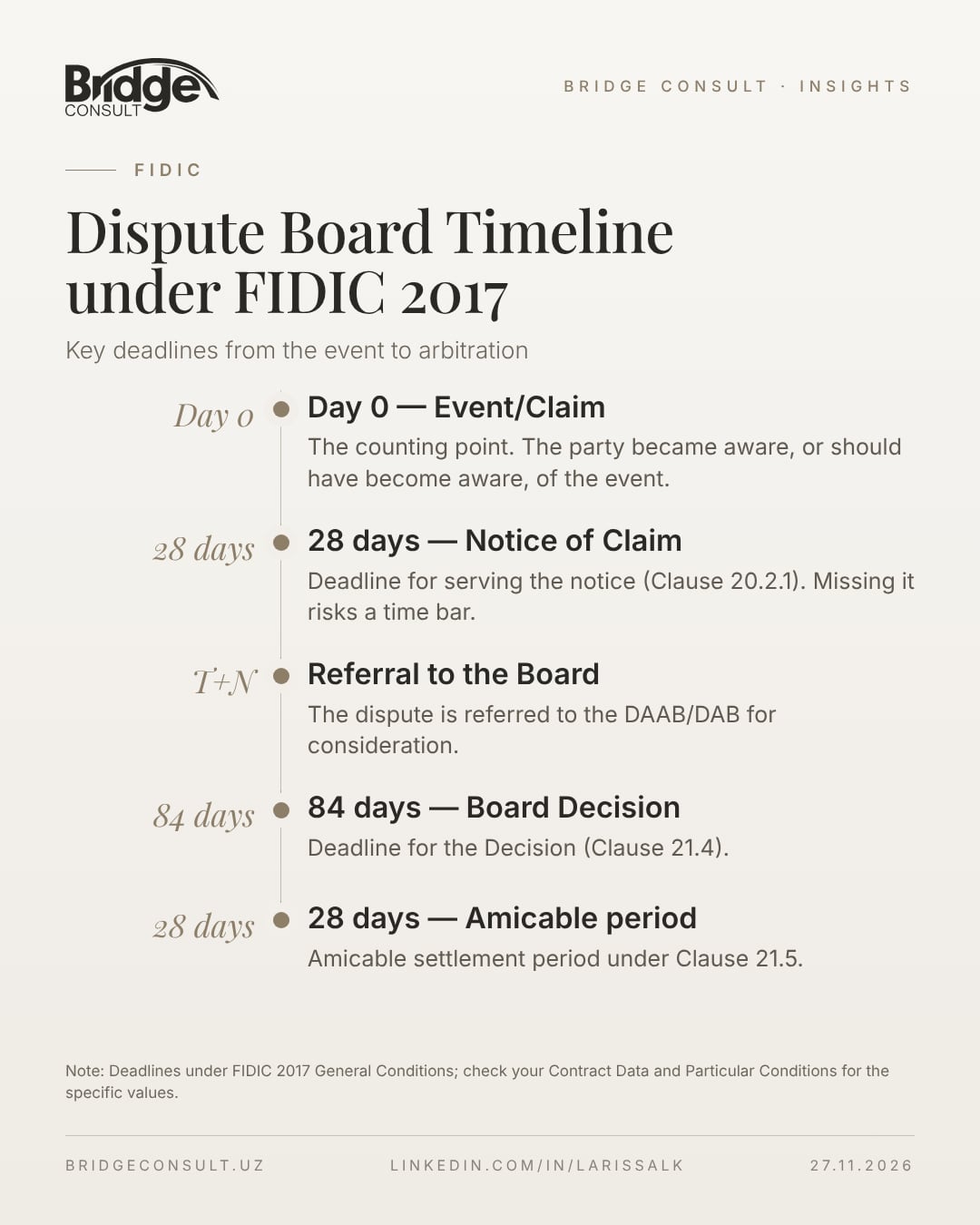
- Deadlines: Board Decision within 84 days of referral (21.4 / 20.3); amicable settlement period after the Decision — 28 days under 2017 (21.5) / 56 days under 1999 (20.5); arbitration if no settlement is reached.
- Materials: which current records (site diary, minutes, correspondence, programme) the Board will rely on.
How to appoint 1 or 3 members: criteria and procedure
Board members must be independent of both parties and competent in construction, contracts and, where appropriate, in quantum. In practice, selection is done in two stages: the parties agree a shortlist of candidates and appoint, or, if they fail to agree, the appointed party or body makes the appointment in accordance with the procedure in the Particular Conditions. The critical point is to fix this in advance — otherwise the appointment of the Board itself becomes a dispute. It is also useful to study how to appoint a Dispute Board and to understand its role.
The general logic follows the General Conditions, unless the Particular Conditions change the procedure.
- Determine the number of members (1 or 3) and the required competency profile.
- Agree on the criteria: independence, construction experience, knowledge of FIDIC and local practice, language proficiency.
- Draw up a shortlist and appoint members within the contract deadline (for a permanent Board — before works commence).
- Fix the remuneration terms and the allocation of costs between the parties.
The Board’s Decision: how it is reached, its legal force and the appeal period
The Board’s Decision is reached within 84 days of referral of the dispute. After the Decision the parties have an amicable settlement period: under FIDIC 2017 it is 28 days (Clause 21.5), under FIDIC 1999 — 56 days (Clause 20.5). If the parties have not reached agreement by then, the dispute is referred to arbitration (21.6 / 20.6). A Board Decision that is not challenged through this mechanism is binding on the parties, but the final decision on the merits is made by the arbitrators. For major international projects in Uzbekistan this may be ICAC or TIAC, or another centre specified in the contract.
Who bears the costs of running the Board in practice
By default, the Board’s costs are shared equally between the parties, unless the contract provides otherwise. The exact formula is set out in the Contract Data and Particular Conditions: member fees, working and travel expenses, currency and the payment method. For an employer on a major project this is usually formalised in the contract budget; for a contractor it is part of the project overheads.
So that finance and accounts do not come as a surprise.
- Ask the Board members to confirm the fee format (monthly, per session, per day).
- Budget for travel: a permanent Board works on site, and travel and accommodation are borne by the parties.
- Reflect the costs in the project budget and cash flow, not just in the general estimate.
Top 5 contractor mistakes when dealing with a Dispute Board
Each of them weakens the position of your Board decision and any subsequent arbitration.
- Late notice: missing the 28-day Notice of Claim window under Clause 20.2.1 results in a time bar — loss of the right to bring the claim.
- Lack of or no up-to-date records (site diary, minutes, correspondence, programme): the Board’s decision rests on evidence, not on argument.
- Unclear Particular Conditions: the member-appointment procedure and cost allocation are not fixed in advance.
- Unbudgeted costs: travel and member fees have not been built into the budget.
- A position submitted without an evidence package: the Board (and any subsequent arbitration) relies on current records and documentation; ‘impressions’ and verbal assertions do not replace the site diary, minutes and correspondence.
Practice: how to prepare for a Board session — documents and reports
A standard sequence that helps you arrive prepared. The specific requirements come from your contract and the Board’s rules.
- Gather the Notice of Claim and all subsequent notices (Clause 20.2.1, full submission within 84 days under 20.2.4).
- Prepare current records: site diary, minutes, correspondence, letters from the Engineer, programme.
- Draw up a chronology of the event, a quantum calculation and an evidence base for each element of the claim.
- Pre-analyse the other party’s position and prepare responses to its arguments.
- Agree the session format with the Employer: agenda, order of presentations, decision deadline.
Frequently asked questions
What is a Dispute Board (DAAB/DAB) under FIDIC contracts?
It is an independent panel of experts appointed under a FIDIC contract to help the parties avoid and resolve construction disputes at an early stage. Under FIDIC 2017 the body is called the DAAB (with avoidance and resolution functions); under FIDIC 1999 it is the DAB (resolution only).
How many members does a Dispute Board have and how are they chosen?
Usually 1 for smaller projects and 3 for larger ones. The selection and appointment procedure is fixed in the Contract Data and Particular Conditions; the parties agree a shortlist and independence and competency criteria in advance, before works commence.
What is the deadline for a Board Decision and the amicable period under FIDIC?
Under the 2017 General Conditions (unless altered by the Particular Conditions) the Board Decision is reached within 84 days of referral, followed by a 28-day amicable settlement period (Clause 21.5). Under 1999 it is 84 days and a 56-day amicable period (Clause 20.5). If no agreement is reached, the dispute goes to arbitration.
Who pays for the Dispute Board?
By default the costs are shared between the parties — often equally. The exact formula, member fees, travel costs and currency are set out in the Contract Data and Particular Conditions of your contract.
What happens if a contractor misses the 28-day Notice of Claim?
Under Clause 20.2.1, missing the 28-day window carries the risk of a time bar — loss of the right to that claim. Notices on disputes and claims therefore need to be served on time, in writing, with the word ‘Notice’ clearly identified.
Sources and references
- FIDIC 2017 Red, Yellow and Silver Books, Clause 21 (DAAB)
- FIDIC 1999 Red, Yellow and Silver Books, Clauses 20.2–20.4 (DAB)
- FIDIC 2017 Red, Yellow and Silver Books, Clause 20.2 (Notice of Claim)
How Bridge Consult can help
Bridge Consult supports employers and contractors on FIDIC contracts — from reviewing conditions and notices to claims, DAAB proceedings and arbitration. Founder Larissa Belousova is a FIDIC Certified Consulting Engineer and an ADB Accredited Contract Management and Dispute Avoidance Specialist.
Have a question about a live contract? Contact us and we will look at your situation.
Read next
FIDIC Uzbekistan
Expert materials, case studies and event announcements on FIDIC contracts in Central Asia — before they reach the site.